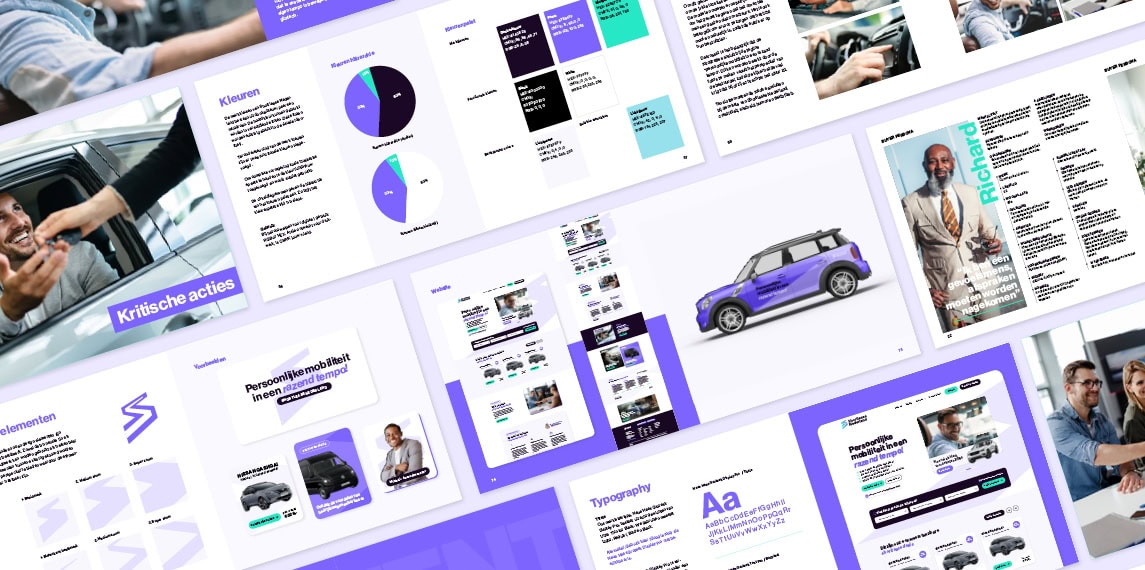
Building brand identity is the foundation of a brand that people remember. Every entrepreneur wants to build a brand that customers don't simply forget. A brand that is recognised, remembered and recommended by word of mouth. The only question is: how do you build that?
The secret doesn't lie in the logo or the name, but in what I call the strategy behind your brand. This article dives deep into the world of brand identity and gives you concrete steps, strategies and insights with which you truly differentiate your brand.
What is this post about?
Brand identity goes much further than a nice logo; it's the soul of your business. This article teaches you how to strategically deploy your core values, visual elements and brand personality. The gems; clear core values, authentic storytelling, consistency and emotional connection with your target audience are what truly makes your brand memorable.
What is brand identity actually?
Many entrepreneurs think that brand identity is the same as a nice name, a logo and house style. But that misses the actual point.
Brand identity is the personality of your business. It's who you are, what you stand for, and how you express that to the outside world. It encompasses:
Your core values
Your mission and vision
Tone of voice (how you speak)
Visual elements (logo, colours, typography)
The way you treat customers
I call this the heart of your brand. It goes further than marketing; it's the soul of your business. That's why a strong brand identity also works so well; it makes you distinctive and unforgettable.
Image: the brand identity for Hypnosekracht.
A well-developed brand identity ensures that customers become loyal and repeatedly choose your brand.
Why building brand identity makes the difference
As an entrepreneur you want three things:
A strong brand identity achieves all three. Why? Because you're not competing on price or features, but on belief. Brands like Apple and Nike don't win because their products are the cheapest, but because customers know who they are and why they do this.
In my work experience as a brand strategist I've seen how a small SME business from Friesland with a clear brand identity became an ever-growing business (more people employed, a new larger premises, more expansion).
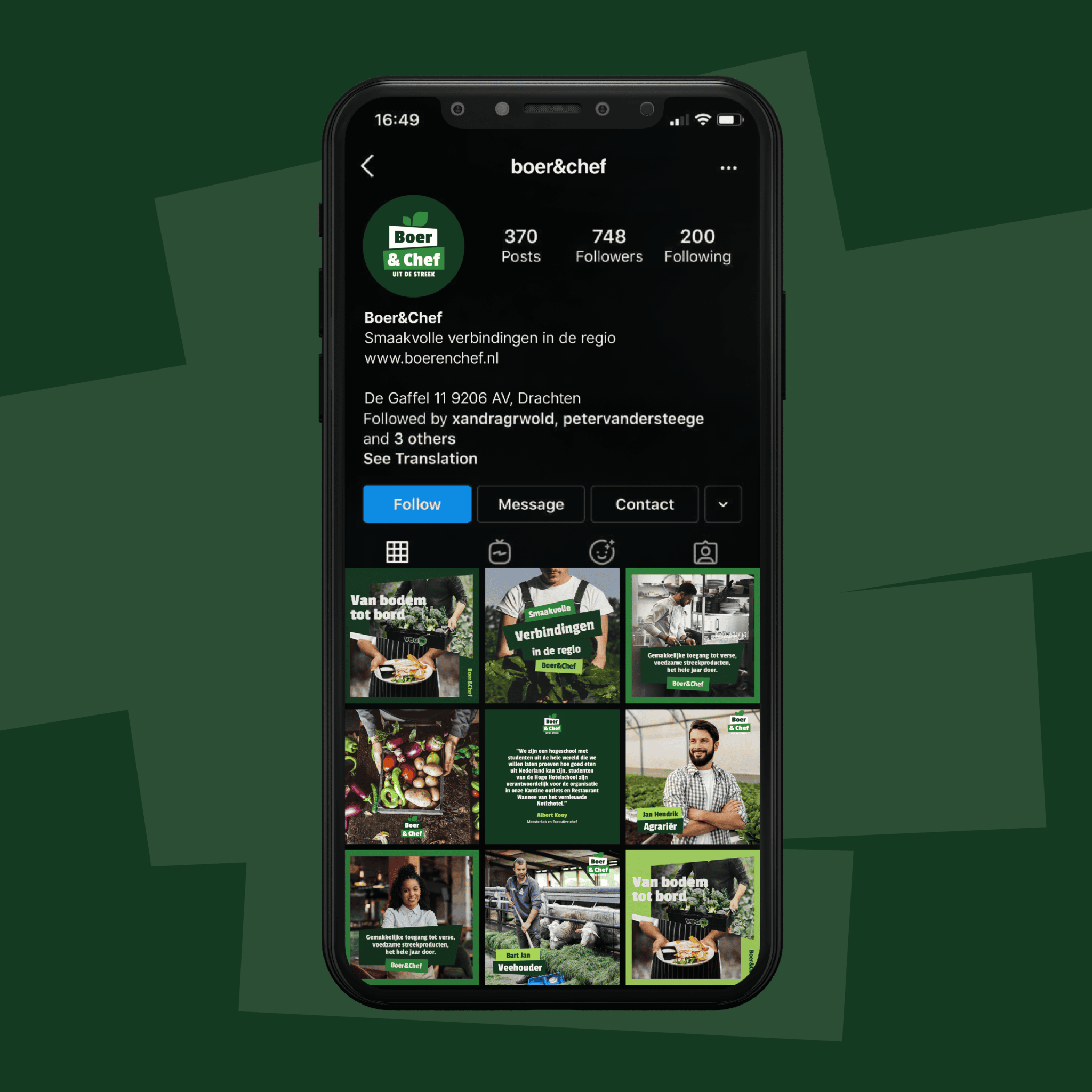
Image: the Boer&Chef brand identity
Brand identity also determines your competitive position. In a market full of similar products and services, brand identity is your only real weapon. Customers choose brands that come across as authentic and consistent; that's what brand identity delivers.
Where do you begin: defining core values and mission?
A solid brand identity starts with the basics. Not with the logo, but with yourself.
Ask yourself these questions:
What is the essence of my brand?
What do we really stand for?
What problem do we solve for our customers?
What world do we want to create?
Core values aren't just words; they determine every decision you make. Reliability, innovation, transparency, sustainability. These values must be tangible in everything; from your customer service to your product design.
Your mission is the why of your business. Not the turnover figure, but the real purpose. Patagonia's mission isn't making profit, but repairing the world. That makes a difference.
By clearly defining your core values and mission, you build a brand identity that is internally consistent and externally comprehensible.
The brand identity model: your roadmap to focus
One of the best models for developing brand identity is the Brand Identity Prism by Jean-Noël Kapferer. This model helps you to set out all elements of your brand clearly and structured.
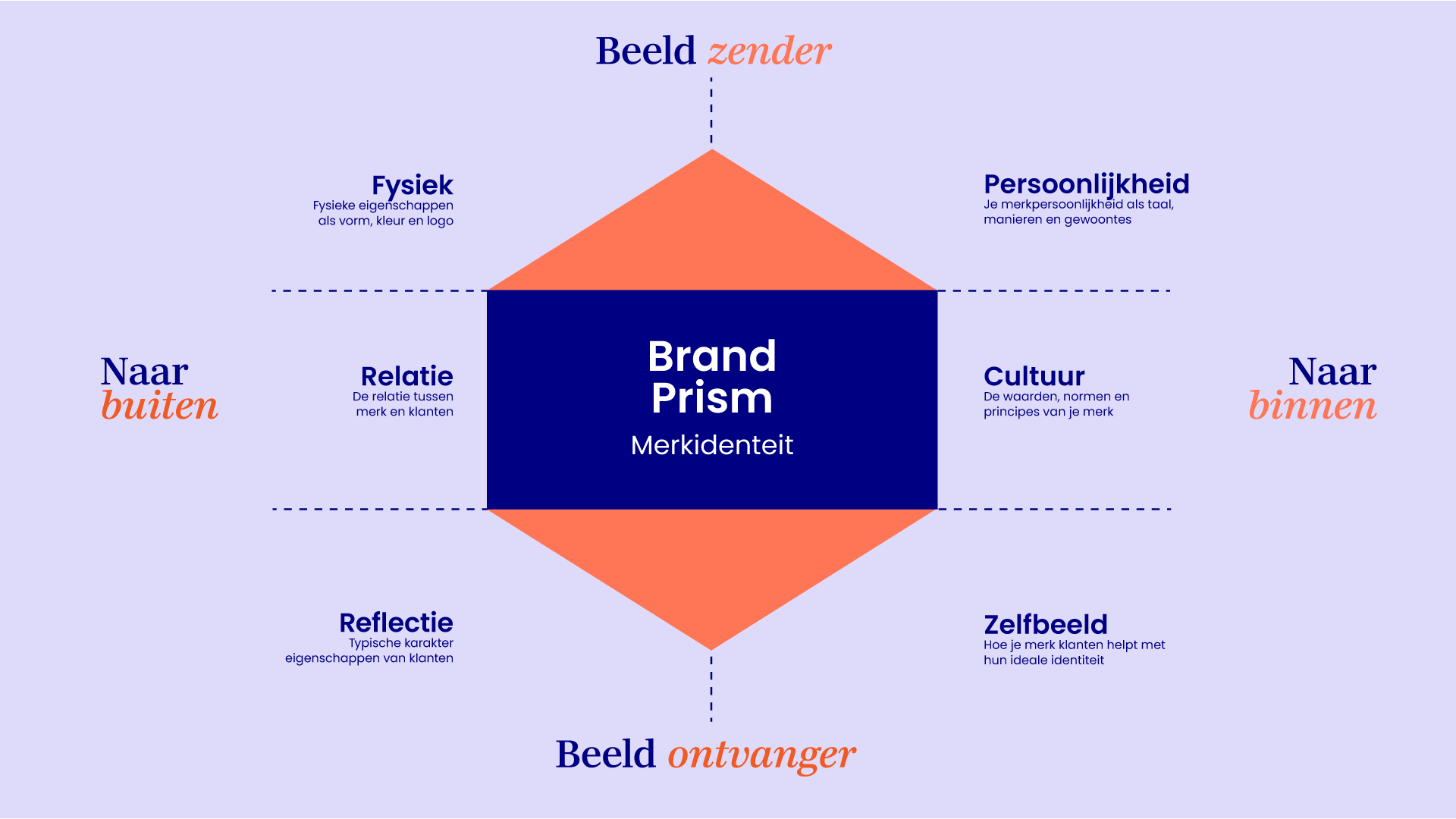
Image: The brand Prism model by Kapferer, J.N. (2012)
The prism distinguishes six aspects:
Physical: what customers see and feel; your logo, colours, packaging
Personality: how you behave; serious, playful, warm, strict
Culture; your values and background
Relationship: the bond you build with customers
Self-image: Who do your customers see themselves as when they choose your brand?
Reflection: How do others see those who choose your brand?
This model works because it helps you to define not only the what, but also the how and why of it.
How do you make a visual brand identity that really works?
Visual brand identity is your first impression. It's what customers see before they actually know you.
This goes somewhat further than a logo. It encompasses:
Logo and logo variants
Colour palette (and how you use this)
Typography (typefaces)
Image style (photos, illustrations, icons)
Visual grammar (white space, layouts, patterns)
The keyword? Consistency. Not that everything looks the same, but that everything is in line with your brand values.
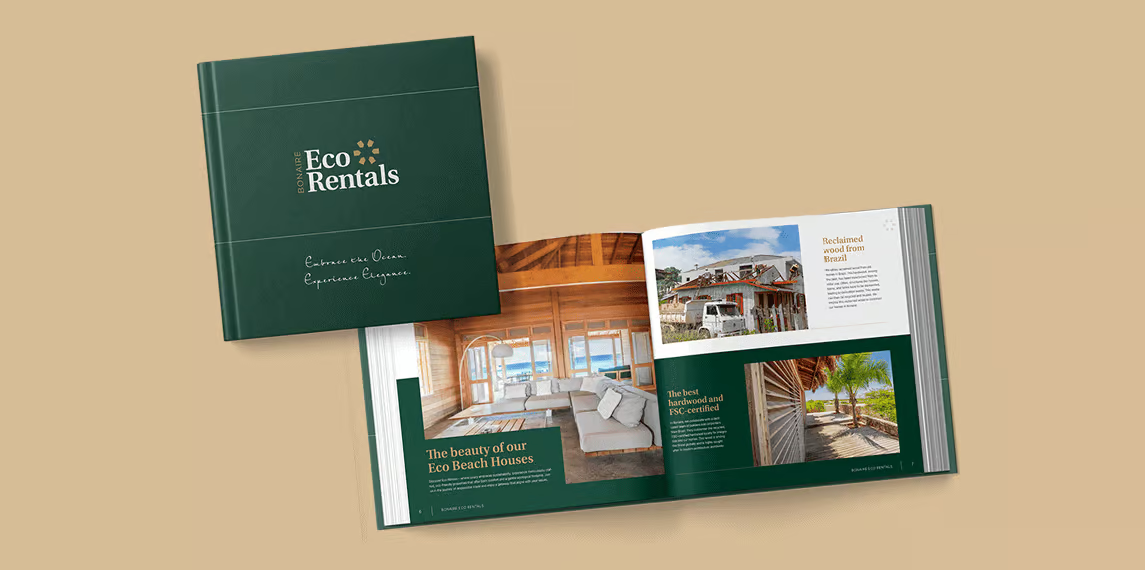
Image: the visual brand identity for Bonaire Eco Rentals.
A brand that stands for sustainability will create a different design than a tech start-up. Do you know why? Because the brand story must be consistent. Patagonia uses natural colours and raw materials; that feels like sustainability. Apple uses large spaces and clean lines; that feels like innovation.
What I often see: the pitfall of inconsistency.
In my workshops and projects I often see the same mistake: entrepreneurs use different visual material everywhere. Different photos, different tones, different colour usage on each platform.
Your website feels like premium, your Instagram like amateurish. Your LinkedIn posts are serious, your TikTok is wildly casual. Customers don't see: How original, they see: Who is this business actually?
This is why many entrepreneurs stagnate in growth. They're not building brand identity; they're building random expressions.
The solution is a brand guide. This is your brand bible; the document in which all guidelines are contained. Tone of voice, colours, logo applications, typography, image style. Everyone in your team references the same document. Voilà; consistency.
Authentic brand identity; not saying, but showing
Consumers are becoming increasingly critical. Bullshit radar on. What still works? Authenticity.
Authenticity is about two things:
True to yourself; you do what you say. Your values come back in your deeds.
Transparency: you're honest. You say what you can do and also where you have shortcomings.
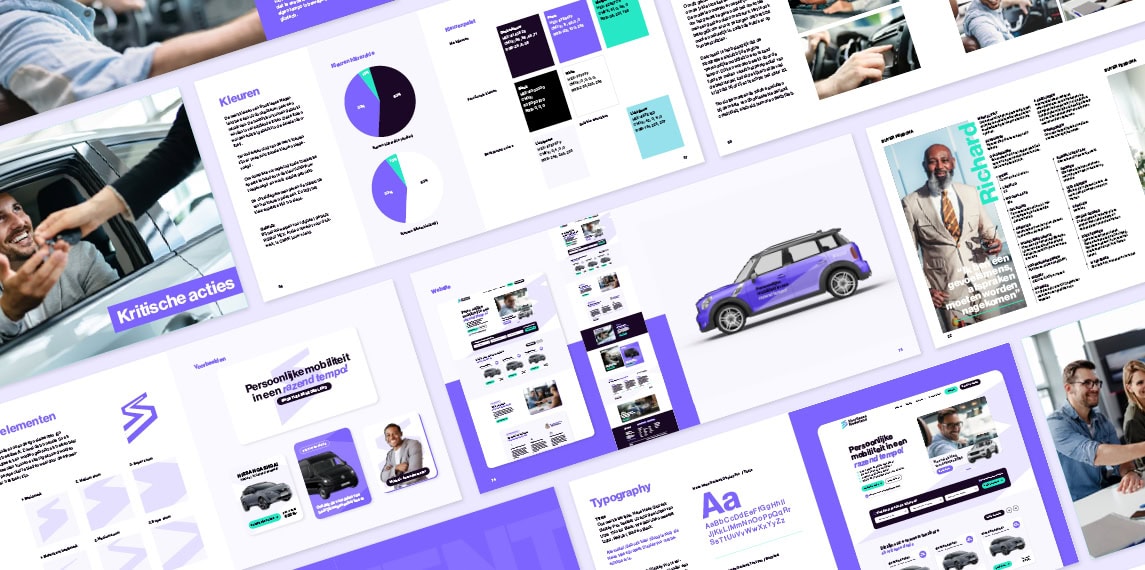
Image: Brand development Shortlease Nederland.
Many brands try to please everyone. They adjust their message to each target audience. That feels fake. Strong brands choose a position and stick to it.
The brand Patagonia accepts no compromises. They stop entire product lines that aren't sustainable, even if it costs them millions. That's as authentic as it gets.
The power of storytelling: stories that stick
Stories are the ultimate brand identity builder. Not because they sound nice, but because they're tangible.
A strong brand identity doesn't tell stories; it is a story.
Ask yourself these questions:
Where did I start?
What pain did I feel in the market?
What challenge have I overcome?
What impact do we really want to have?
These are the stories that bring your brand identity to life.

Image: Billboard for Hotel Restaurant Aduard.
I experienced this myself when I worked for Hotel Restaurant Aduard. They had a superb story: from parents to children, three generations, the same table where all the memories were created. When they started telling that story (instead of explaining their menu), they went viral amongst local food lovers.
Storytelling doesn't work because it's fake, but because it's real.
Brand personality; give your brand a face
This is where the human aspect of your brand identity lives.
Imagine yourself: if your brand were a person, who would that be? Energetic and playful? Or serious and reliable? Cautious or reckless? Formal or informal?
That personality determines:
Nike's brand personality is the inspirer. It's never condescending, always encouraging. That comes through in their copy (Just Do It), their campaigns and even their customer service.
A clear brand personality helps you to:
Attract customers who feel recognised
Consistency in every interaction
Make faster and better decisions as a brand builder
How do you ensure your brand identity remains consistent?
Consistency is where many brands go astray.
You start brilliantly; strong brand guide, everything consistent, everyone feels the energy. But then:
Your team grows and new people don't know the brand guide
You take on other channels (TikTok, Pinterest) and adapt.
You bring in outsourcers and they don't follow your guidelines
The trend looks fun; you deviate briefly
Six months later? Your brand identity feels confusing.
You prevent this by:
Updating brand guide; make it a living document, not something you create once
Training your team; ensure everyone understands why brand identity matters
Regular audits; check every six months whether you're still consistent
Experimenting within boundaries; Renew yourself, but remain recognisable
Brand identity in transition; what now?
You notice that we live in fast-paced times. Algorithms change, consumer behaviour shifts, partly due to AI and other technologies.
This places demands on your brand identity. Not because you must change it, but because you must remain flexible. Your core values stay the same, but the way you express them can evolve.
Ask yourself these questions:
Does my brand identity still resonate with my target audience?
Are there new channels where I can better express my brand?
How can I remain relevant without being untrue to myself?
This is also why LinkedIn strategy is now becoming so important for brand strategists like me. Not as a sales channel, but as a platform where brand identity becomes directly visible. Your voice, your stories, your authenticity.
If you notice that your brand identity feels tired, this is the moment to refresh it.
How emotions bring your brand identity to life
This is where the real magic lies.
People don't buy based on features; they buy based on emotions. Apple doesn't sell a computer with 48GB RAM; Apple sells liberating your creativity. Tesla doesn't sell a car with 500km range; Tesla sells your contribution to the future.
What emotions do you want customers to feel when they experience your brand?
Build your brand identity around this emotion. Let it resonate in everything: visuals, language, service, timing.
A brand that does this perfectly? Starbucks. They don't sell coffee; they sell a moment for yourself. That comes through in their stores (warm interior, places to sit), their naming on cups (personal), their music choices. Everything works towards one emotion.
Practical checklist: how do you start today?
Step 1: define your core values
No more than 5. Ask yourself: what do we truly stand for? Say this to yourself until it feels like truth.
Step 2: write down your mission
Not what you want to sell, but what world you want to create. What would disappear if you weren't here?
Step 3: define your brand personality
Who is your brand as a person? Describe this in terms like energy, humour, serious, formal, warm.
Step 4: create your brand guide
Logo, colours, typography, tone of voice. This is your reference.
Step 5: test for consistency
Take your last 5 posts, images, website and ask yourself: do these feel the same? Or do they seem like 3 different companies?
Step 6: train your team
Ensure everyone understands why brand identity matters and how they contribute to it.
Step 7: listen to your customers
Ask for feedback. Does your target audience understand your brand identity? Do they feel your values?
Examples of strong brand identities in action
Nike: Just Do It isn't just a slogan. It's an attitude. Nike's brand identity revolves around achievement, perseverance, self-conquest. You're an athlete or you're not; Nike encourages you to push your boundary. This is reflected in every campaign, every product, every interaction.
Tesla: innovation and sustainability in a vehicle. But it's more: Tesla declares you as a forward-thinking person. Their mission is clear: transform transport and save the planet. That comes through in their production part, their events, their communication.
IKEA; A better everyday life for many people. Not luxury, not status, but practical. Accessible. Dignified. This determines their design, their pricing, their stores, their marketing. Nobody associates IKEA with "too posh for me", on the contrary.
The role of customer experience; your brand identity comes through
Brand identity doesn't only live in your marketing. It lives in every interaction.
A customer visits your website. The experience feels rushed, contradicting your slow brand mission. Wrong. They call your customer service. The agent is brusque, not aligned with your empathetic core value. Wrong. They receive the product. The packaging feels cheap, not aligned with your premium positioning. Wrong.
Brand identity stands or falls with customer experience. That's why I don't only work on logos and copywriting; I work also on customer journeys, service protocols, internal communication.
This is what builds recognition. Not your logo on a billboard, but that every interaction feels how you say it does.
Adapting brand identity without being untrue to yourself
This is a big question I hear often, especially now we're in transition.
Market changes. Consumer behaviour changes. AI changes things. Your target audience changes.
Must your brand identity change? Sometimes yes, sometimes no.
Your core values remain the same. Always. That's your anchor. But how you communicate those values can evolve:
Visually you can refresh yourself (new colours, new logo)
Your tone of voice can mature (less boyish, more wisdom)
New channels can better express your values
New partnerships can strengthen your mission
The secret is; ask yourself regularly; does my brand identity still resonate with my target audience? Is there still energy in my brand? Where can I grow without being untrue to myself?
This is also why LinkedIn is becoming so interesting for brand strategists like me. We can directly test there how our brand identity resonates. Real-time feedback.
In short: building brand identity is your most valuable investment
A strong brand identity isn't something you make and you're done. It's something you nourish, protect and evolve.
It's your most valuable asset as an entrepreneur, because it determines whether customers return or disappear, whether they recommend you or forget you, whether your brand grows or stagnates. Research from Interbrand shows that strong brands structurally outperform generic competitors — brand identity is literally worth money.
Read more about my approach or see how I work on brand identity.
In my 35+ years as a brand strategist I've seen hundreds of brands pass by. The ones that stayed all had one thing in common; they had a clear, authentic, consistently executed brand identity. The others were all unique snowflakes; original but unnoticeable.
You can achieve this too. Start today. Define your core values, write down your mission, create your brand guide, and ensure every interaction (website, post, customer service, packaging) feels aligned.
It's not rocket science, but it requires focus. And that focus delivers what you want; a brand that sticks.
You've read the entire post. Fantastic! Should you want to get serious about your brand identity. Read on here.