You've got everything in order, but where is your character?
The right brand archetype makes the difference between recognition and interchangeability. Many companies want to be more visible. They have a strong offering, deliver good work and receive positive feedback from clients. But when it comes to brand positioning, things often remain vague. Instead of direction and character, we get hollow phrases like 'quality', 'commitment' and 'personal approach'. Terms that could appear in any random company brochure. And which therefore don't truly resonate with anyone.
Most brands are interchangeable. They try to communicate broadly and appeal to everyone, but as a result they disappear into the grey middle ground. Their identity is as flat as a PowerPoint template: professional-looking, but empty inside. The brand resembles a play in which everyone is on stage, but no one knows which role they're playing.
This leads to confusion. Among clients and within the team. Because if you don't know who you are as a brand, it's also difficult to make choices in communication, presentation and client approach. And ultimately what you'd rather not have happens: potential clients don't recognise you, don't remember you, and choose someone else.
Both start-ups and established companies struggle with this. They feel there's more to it, but they're missing a hook. A clear role. Something that makes their brand recognisable, appealing and attractive.
The missing link is often the right archetype for your brand.
Why positioning without a brand archetype fails
Most companies begin positioning from the head. They want to differentiate themselves and so they put core values on paper, write a mission and give their vision a lick of paint. Logical enough. Except: that head often forgets something important.
Namely, feeling.
Strong brands, whether they're multinationals or local specialists, succeed in being more than just their offering. They radiate a character. You feel intuitively who they are and what they stand for. Not only rationally, but also emotionally. Think of companies like Apple, Tony's Chocolonely or IKEA. You don't only know what they do, you also feel what they want to mean.
That's because they play a clear role in their target audience's mind. That's precisely what an archetype does: it gives your brand character, direction and recognition.
Without such a role, your positioning remains superficial. You might say, for example, that you 'offer the best service', or that 'quality comes first with you' – but that message doesn't land. Why not? Because you're only still broadcasting. You're not building a relationship.
Clients don't recognise themselves in abstract terms. They connect with stories, with behaviour, with presentation. And that requires consistency.
A brand without an archetype lacks direction, sharpness and persuasiveness. Everyone is running hard, but no one knows in which direction. And then you lose. Again and again.
What are archetypes and why do they work so well?
The twelve brand archetypes are originally based on the model of Carl Jung. Later this was translated into brand communication by Margaret Mark and Carol Pearson in The Hero and the Outlaw. A brief background can be read on Wikipedia about archetypes.
An archetype isn't a trick. But it's also not a science. It's a lens through which you look at your brand and with which you show yourself crystal clear to the outside world.
The idea comes from Carl Jung, who proposed that people across the world unconsciously recognise the same types of characters in stories: the hero, the sage, the rebel, the explorer. Think of the role distribution in films, books, myths; but also in brands.
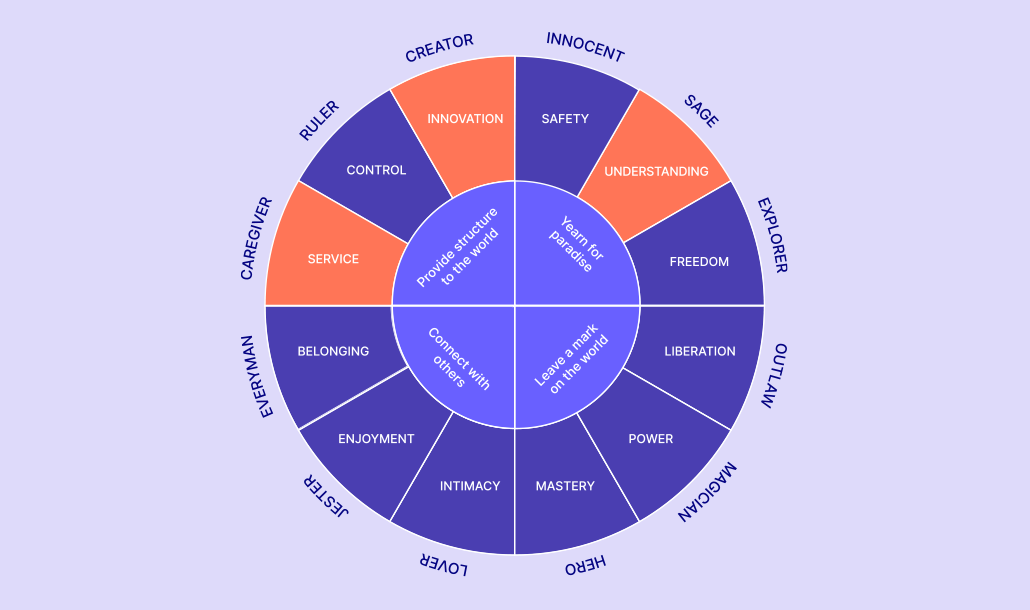
Image: Incidentally, it's not at all bad to choose a combination of several archetypes, as in this example (three at once). As long as they reinforce each other, it works fine.
An archetype gives your brand a recognisable personality. And that works, because people are more likely to remember something that feels like a human being than like a job description.
So you no longer need to guess at your tone of voice or your visual style. The archetype shows you the way. It makes clear: are you the caregiver or the hero? The jester or the rebel? The magician or the nurturer?
And more importantly: it ensures consistency in your communication. If your brand is a sage, then you speak differently from a rebel. You make different choices in imagery, language, colours, campaigns.
A well-chosen archetype gives you grip. It's an anchor point for branding on character and consistency. Not branding on feeling, but on character.
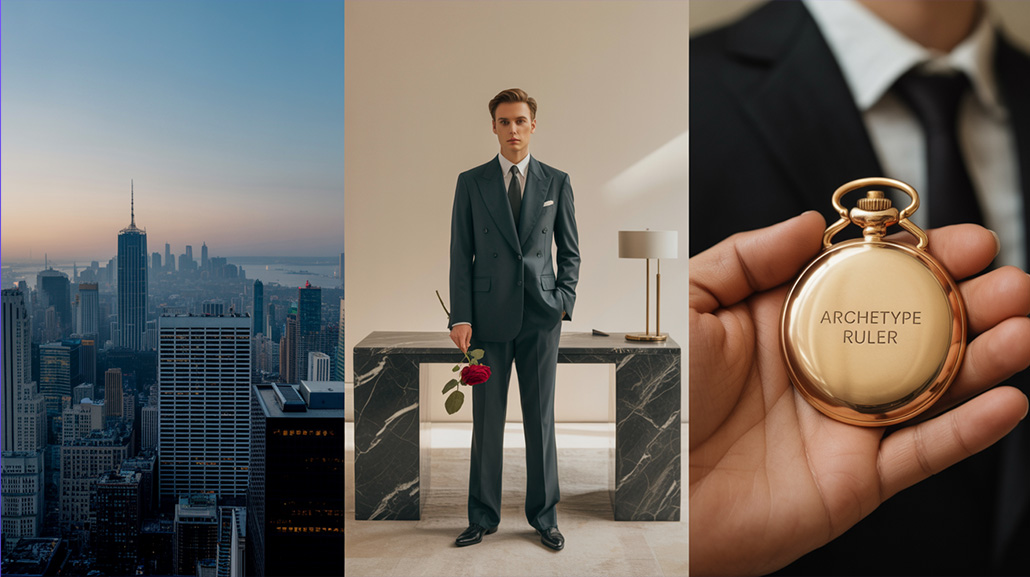
Take, for example, the entrepreneur (business coach) who works from the archetype of the Ruler. He radiates authority without becoming authoritarian, and his clients immediately feel: here is someone who brings structure. His brand breathes control, overview and leadership. No loose shots, but a clear method with results. His website is sleek, his language is considered and his programmes are built like a well-oiled system. You feel: this isn't a coach who muddles along with you, this is someone who takes control and takes you to a higher level.
That's why it works. Because it's right. Because everything in the brand strikes the same chord.
If you want to build a brand that sticks, then you must choose who you are and especially: who you're not.
How an archetype gives your brand direction and courage
A while ago I worked with an organisation that specialises in sustainable construction technology. The team was full of experts, the portfolio was rock solid, and the clients were genuinely satisfied. But the brand? That was colourless.
Their texts were correct, but dull. Their website felt like a digital annual report. And in conversations with potential clients it took far too long before it became clear why they were different from the rest of the market.

And from that moment something changed
During a positioning process we discovered together that their brand carried the archetype of the sage within it. Not the hero or the rebel. But the thoughtful expert who makes complex things simple.
They began to speak differently. Less broadly, less woolly, more to-the-point. Their new brand voice radiated calm and trust, without becoming preachy. Instead of bombastic marketing language came clear insights and clever connections.
Their website gained structure and rhythm. Case studies were no longer only about results, but about the process and the choices along the way. They no longer demonstrated their expertise with jargon, but with understandable metaphors.
And the best part? The team recognised themselves in it. The archetype captured their brand identity so accurately that they didn't need to adjust. It felt like coming home. The archetype gave their identity words, without it becoming a play.
An archetype isn't a costume, it's a magnifying glass.
And that makes it so much easier to choose direction, determine style and make choices that fit.
Because that's perhaps the most important advantage: an archetype ensures internal alignment and external recognition. Your brand feels consistent, rings true and sticks. Everyone knows what the brand stands for, what behaviour belongs to it and what story you tell.
In short: choose a brand archetype, not camouflage
Without an archetype a brand remains vague.
A bit of everything, but nothing that stays with you.
And that's a shame. Because whether you run a scale-up, lead a creative agency or have a service organisation: your brand deserves to stand out.
An archetype helps you make choices. Not pigeonholing, but a sharp positioning based on character. They turn your brand into a recognisable personality. Someone clients can connect with.
Because ultimately no one wants to work with a vague entity.
We choose brands that have character. That make us feel something. That know who they are.
A well-chosen archetype doesn't give your brand a mask, but a human face that stands out and sticks.
One voice. One direction.
Are you ready to make that face clear?
So that clients recognise and remember you?
Then view my approach on the page about Expert brand identity.
There you can read how I work together with companies on a strong brand identity — from strategy to design and content.
Do you want to go a step further and discover how your unique character also becomes visible in your presentation and behaviour?
Then read my page about personal branding.
Because a brand without a face is anonymous. And anonymity doesn't sell.