Why the shine of personal branding has faded
Personal branding was once the weapon of a select group. Now it's the standard. We live in an era in which everyone is their own publisher. Never before has it been so easy to position yourself, publish and position yourself as an expert. At the same time, it has never been so difficult to stand out. The platforms are overcrowded, the algorithms unfathomable and your audience's attention span shorter than ever.
In this digital era, personal branding is no longer a luxury or a trick for influencers, but an indispensable part of professional success. Because connection has become central, its meaning has changed incredibly rapidly.
Where personal branding once revolved around consistency, control and mapping out a clear positioning, we now live in an age of hyperindividualism. Everyone is already a brand. Consciously or unconsciously. Authenticity is no longer a strategy, but a prerequisite.
We no longer choose our connections and collaborations solely on the basis of status or expertise, but on the basis of trust, recognition and shared values. According to researchers such as Jean Twenge, this extreme focus on the individual is a characteristic of our generation, reinforced by technology, social media and the culture of constant self-expression.
In such a context, the term personal branding itself has almost become superfluous. What counts is connection and above all real connection. And that rarely happens in a perfectly styled post, but increasingly often in an honest conversation, a live call or an unexpectedly spontaneous contact moment.
LinkedIn as barometer: from loud platform to intimate professional table
When I gave a series of workshops on 'becoming visible on LinkedIn' in early 2023, the standard question was: How often do I need to post to please the algorithm?. By now, this is an outdated reflex. Because where LinkedIn used to get away with tightly planned content calendars and obligatory like if you agree! calls, the platform has shifted in barely two years from loud platform to intimate professional table. The new game is less shouting loud, more thinking aloud.
Two stories from practice
You can see this in the small stories that suddenly go viral. Take Elvi Caperonis, an almost unknown HR consultant from Athens. She decided every Thursday to share a mini-case about a hiring mistake that she herself had made. No sparse emojis, no link to a whitepaper. Just an honest mistake, the lesson and a question to fellow professionals. Within a quarter, that transparency brought her more commissions than three years of advertising. The algorithm certainly played a role in this, but more important was that fellow professionals recognised something that too often remains hidden behind shiny success stories: humanity with professional knowledge.
The opposite is just as instructive. A growth-hacker who called himself 24/7 Lead Machine bombarded hundreds of prospects daily with automated connect requests, supported by a like-pod full of applauding puppet-show friends. A few weeks later his account was flagged: restriction for 'fake engagement'.
Not because LinkedIn didn't like the man, but because the signals of real interactions, such as typed responses, reading time and saved posts, were absent. In a timeline that increasingly cleverly weighs what truly has value, tricks are quickly traced.
What you take from this
What do those two extremes mean for you? Simple: LinkedIn is no longer a digital billboard on which you shout in neon letters that you're available. It behaves like a continuous professional journal in which experts question one another, challenge and not unimportantly also attract clients by showing how they think.
Those who dare to give away knowledge, ask questions to which they don't yet know the answer, and then move the conversation to a live call, build a reputation that can't be copied with any advertising budget.
And with that we close the circle to where this blog began. In a time of hyperindividualism and abundance of digital noise, your brand is only credible if it invites conversation (not applause). LinkedIn is merely one arena for this. Those who understand the principle apply it just as easily in webinars, podcast interviews or a coffee conversation without a camera. Because personal branding may be worn out as a term, the need for real connection is alive and kicking.
Personal branding beyond the hype
Personal branding is no longer a trick; it's the default setting of a society that has become increasingly individualistic. Some even say: hyper-individualistically configured. Yet recent research shows that, precisely because everyone now broadcasts, we yearn more for real reciprocity: 64% of professionals cite a (hybrid) video call as their favourite way to deepen new business relationships, even before email or chat. In other words: we want to see, hear and digitally shake hands with the face behind the brand.
At the same time, the bar for credibility is shifting. Transparency is not a clever pose, but a hard requirement. Brands (personal or corporate) that dare to be radically honest win trust more quickly. Forbes doesn't put tailored authenticity and expert guidance in micro-niches right at the top of the personal-branding-trend list of 2025 for nothing.
What does this mean for you?
Embrace your micro-niche and own it. Don't talk to everyone who does something with business, but to that one subgroup that really needs your experience.
Show the rough edges. Made a mistake? Share the lesson. Client case with bumps? Show the process. Radical honesty is currency.
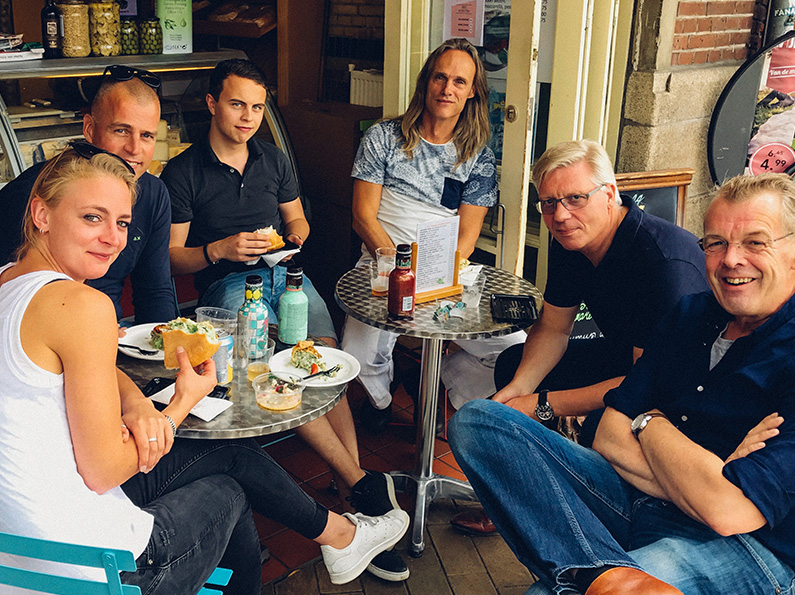
Move the connection from feed to face. End content with an invitation for a short video call or a live session; that's where the relationship is converted.
Build rhythm, not façade. Consistent, small proofs of expertise weigh heavier than one polished brand video.
In short: personal branding beyond the hype
Not more visibility, but real connection. That's the essence of personal branding in 2025. View my approach or read more about brand identity as foundation.
Further reading and doing
Are you ready to make the entire journey from your why to a strong online identity a reality? On my page 'Turns your expertise into a brand identity' read further how I help you with this, from strategy to design and content. View the possibilities and take the step today towards a brand that is not only visible, but also tangible.
Authenticity without interaction is merely décor. Interaction without expertise is noise. Combine both and you build a brand that can't be copied.