Your brand has a voice. A real voice.
Tone of voice is the voice of your brand — and that voice is not that generic, pre-chewed formulation that 90% of your competitors use. But your unique way of saying what you do, why you do it, and why someone should listen.
In 2025, that voice determines more than ever what your customers think of you, remember about you and ultimately choose. That's tone of voice; and it's not just nice to have. It determines whether you stand out or disappear into the crowd.
Your voice determines whether you stand out or disappear into the crowd
Your tone of voice is how your brand speaks, and this directly influences trust and conversion. First define your core values, observe how your target audience communicates, and integrate your tone of voice into everything you publish. In 2025, a strong, authentic voice also helps with voice search, AI overviews and Google's E.E.A.T. criteria; make sure you show concrete examples and real expertise.
What is tone of voice really?
Tone of voice is not just the words you write. It's the way you write them. It's the tone, the rhythm, the perspective and the energy behind every message.

Take Oatly.
They could write: This is a plant-based alternative to dairy products with sustainable raw materials. Factually completely correct, but extremely dull. Oatly writes: It's like milk, but made for humans. Boom. The same message; completely different effect.
Or look at your own industry. How many brands use the same, limp corporate language? We prioritise quality and Customer focus is our priority. You fall asleep, don't you?
Whilst a brand that says: We don't sell you nonsense; our method works or you get your money back. gets far more response.
That difference, that authentic note; that's your tone of voice.
Why does tone of voice matter now more than ever?
1. You differentiate yourself in a sea of similar offerings.
Customers see products that are almost identical. Your tone of voice is what draws them in, touches them and keeps them. With a strong voice you say: This is me, this is how I work, and this is for you if you value this. No grey area, no windfalls.
2. Voice search and AI overviews reward authenticity and clarity.
Google's algorithms look for content created by people with real expertise. Not stuffed, generic AI slush. A strong, personal tone of voice signals: here's knowledge, here's opinion, here's someone who knows what they're talking about. That helps with findability.
3. Trust grows through consistency and recognition.
People buy from brands they know and trust. Your tone of voice creates that recognition. Every time someone encounters you, they think: Yes, that's their voice. I know what I can expect. That builds
What are your core values actually?
Before you can determine your tone of voice, you must first know your foundations. What are your core values?
These are not your mission and vision; these are the principles you truly believe in. For me as a brand strategist for example: thinking proactively, trusting intuition, authenticity over perfection, humour to connect.
Those values determine everything. They determine what tone you adopt, which stories you share, and how you tackle challenges.
An exercise for yourself
Write down three core values of your business. Not what it should be, but what it really is. Which three principles guide you daily?
Now; how would those values sound in a sentence? If your value is fairness, do you say differently than: Our prices are competitive? Or do you say: You pay what it's worth, no more, no less?
See? The values determine the voice.
How do you determine your tone of voice?
This happens in three steps.
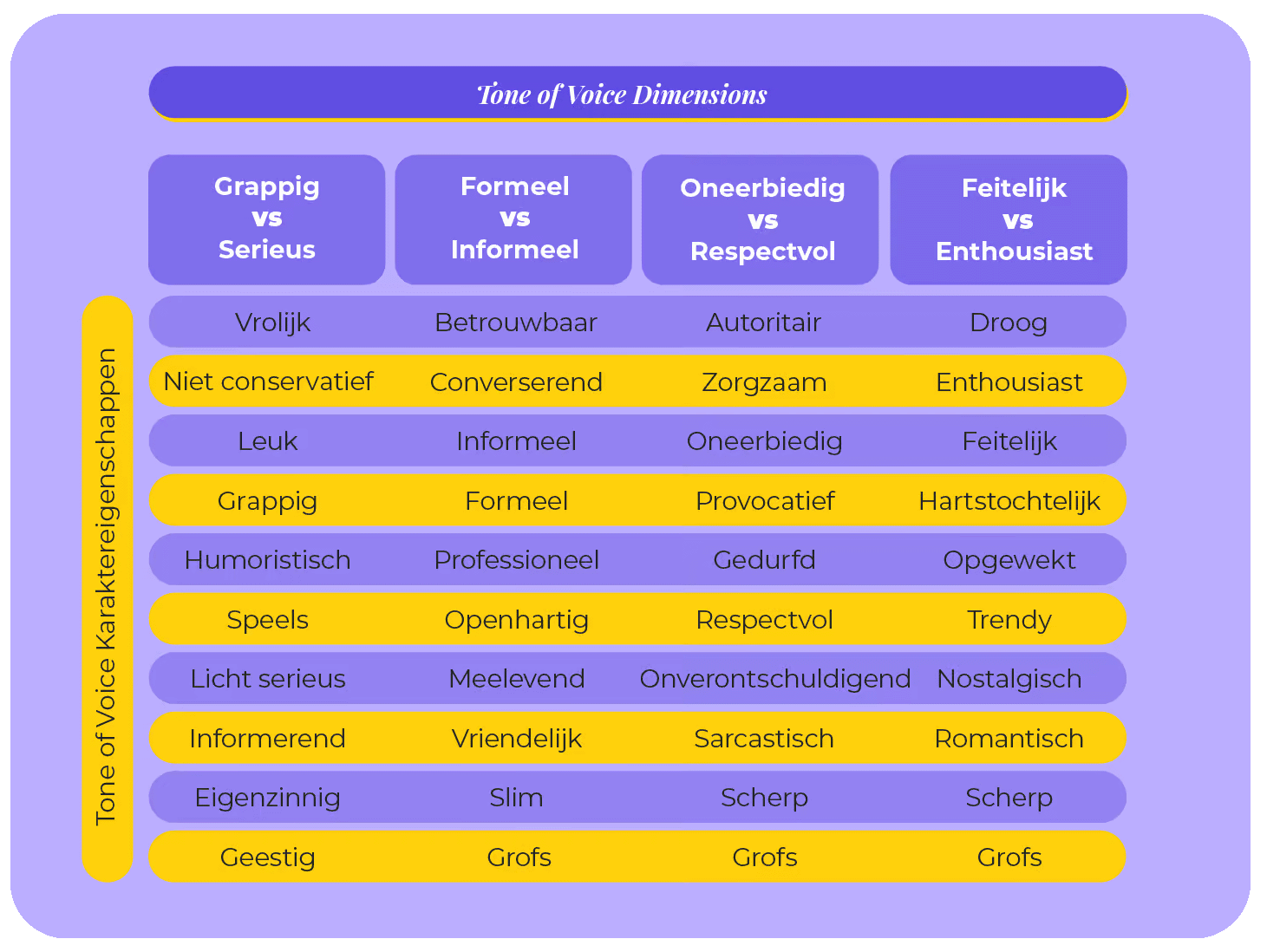
Step 1: define four dimensions.
Describe yourself on these four axes:
→ Funny to serious; where are you?
→ Formal to informal; what's yours?
→ Respectful to irreverent; how directive are you?
→ Enthusiastic to factual; what's your energy?
You don't have to be at extremes on all sides. I'm for example formal average (rather informal), funny average (rather funny), respectful on the high side, and enthusiastic on the high side. So: informal, funny, confident and engaged. That becomes my core.
Step 2: observe your target audience.
How do they communicate? Which tone appeals to them? Young people on TikTok communicate completely differently than entrepreneurs on LinkedIn. Your tone of voice must fit into their world; otherwise it feels strange.
Take time. Listen. Read how your ideal customer speaks, makes jokes, describes problems. What is their language?
Step 3; write examples.
Not vague guidelines; concrete examples. How would you say what you say? Write five messages in your tone of voice. Read them aloud. Do they sound like you, or like a template? Perfect is boring; authentic is accurate.
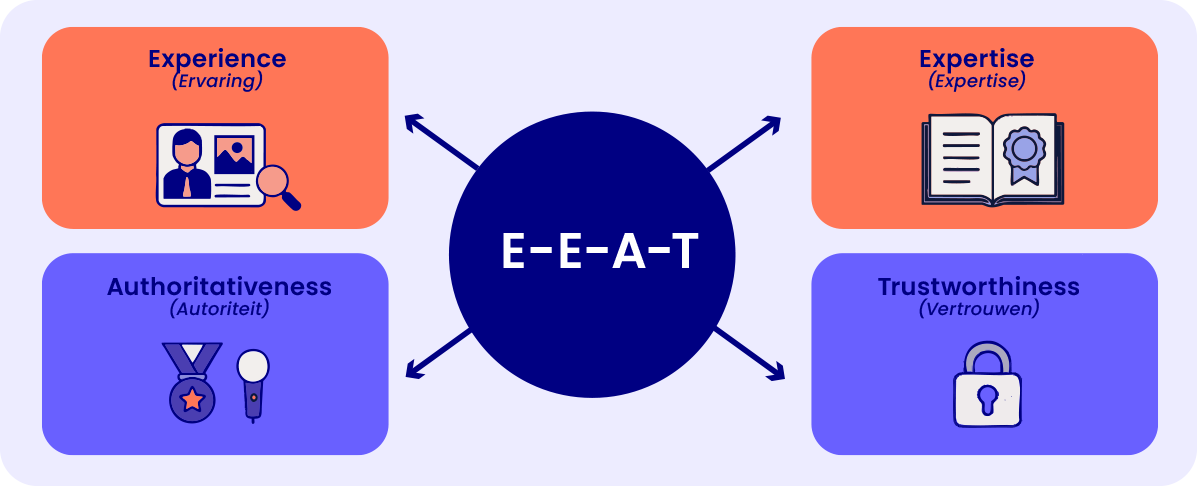
What does E.E.A.T. do and why is it so important?
Google's Search Quality Rater Guidelines increasingly emphasise E.E.A.T; Experience, Expertise, Authoritativeness and Trustworthiness.
This doesn't mean you can put Dr. before your name. It means you demonstrate: you genuinely have experience, you know your profession, other sources cite you, and you're honest about what you do and don't know.
In practice:
Experience. Share concrete cases and projects from your own work. A blog about how you build a brand is BORING until you describe a real case; client X had a particular problem, I did this, this was the result. Boom; suddenly credible.
Expertise. You don't have to stick your diplomas on the homepage; but you must subtly show that you've been doing this for years. In my 35+ years as a brand strategist I've seen that… says enough.
Authoritativeness. Link to better sources than yourself. Cite research, trade journals, experts. Google sees that you're not alone; you build on the work of others.
Trustworthiness. Be honest. Say what you don't know. Admit that this topic can also be grey and complicated. Nobody trusts someone who always knows everything.
A small bio at the bottom of your article with photo, links and relevant experience helps enormously.
How do you ensure your tone of voice remains consistent?
Inconsistency is a mortal sin for a brand. If you say on Monday we're informal and funny, but write on Friday like an accountant; your audience gets confused.
Five practical tips:
1. Document it. Write down your tone-of-voice guidelines. Not only abstract (we're human), but with examples. We do say this: and We never say this. Share this with your team.
2. Read aloud. Before you publish anything; read it aloud. Does it sound like you or like AI? Would you say this to a customer over coffee? Yes; publish. No; rewrite.
3. Train your team. Everyone who writes on your behalf must know your voice. Share examples. Let them practise. Give feedback focused on tone, not only on grammar.
4. Integrate it into everything. Website, email, social media, customer service, podcast, white papers. The same voice everywhere. That makes you recognisable.
5. Evaluate regularly. Every six months: does this still work? Or have I changed, is my audience growing, are my values shifting? Tone of voice is not set in stone; it may evolve.
Which mistakes do you really not make?
Don't start with compliments. Get straight to the point. Your audience sees through this kind of flattery; it feels fake.
Don't pretend you're an expert in everything. That works against you. Acknowledge where you're stronger and where you're not at home. Much more credible.
Don't use twenty different tones. Choose one voice and stick to it. People recognise you then.
Don't forget that the reader is central. Your tone of voice is not about you; it's about how you speak for them. So: write from their perspective, understand their problems, use their language.
In short: tone of voice as a strategic tool
Tone of voice is not a style guide, it's an attitude. Those who consistently deploy their voice build recognisability and trust. View my brand identity approach or read more on my approach page.
An example from my own work
A few years back I worked with a tech start-up that ran into the same challenge. Their product was good, but their communication felt like that of three hundred other tech start-ups.
So: dull, corporate, soulless.
We redefined their tone of voice. Result: direct, informal, funny, honest about their limitations, but shameless about strengths. Concretely, this meant: reviews were a proposal, not a presentation; blog posts began with why this subject is really difficult, not why they are the solution.
And the result? Engagement on social media rose 340% in six months. Requests for collaborations doubled. Not because they got better; because they finally sound like themselves.
That's what your tone of voice can do.