AI gives everyone the same superpowers now. The same answers. The same templates. And yet some professionals will soon be worth more than ever. The reason? Humanity. Not as sentiment, but as strategy. The difference comes down to three letters.
No time? Here's the core
AI makes information free and infinitely available. But knowledge is something else entirely. Real knowledge only emerges when you combine information with your Experience, Skills and Attitude (ESA). In a world where everyone has access to the same AI tools, these three elements become your most important differentiator. It's not what you know that makes you valuable, but what you understand and what you do with it.
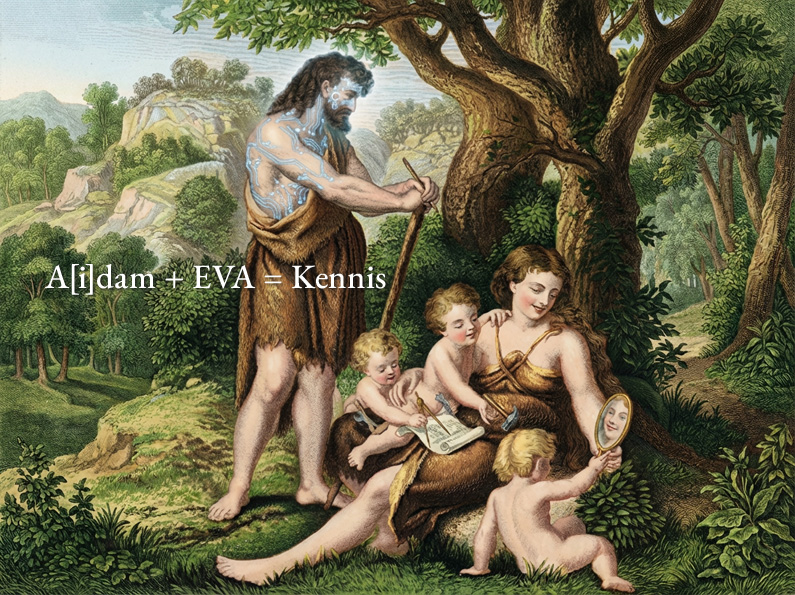
A[i]dam and Eve are condemned to each other once again
A[i]dam and Eve were once the first people on earth. Now they're condemned to each other once again, albeit in a different configuration. One fills the world with information, the other brings understanding. Adam, threaded through with digital circuits, teaches his children from a book. Eve looks in the mirror and sees herself. Self-knowledge versus data-knowledge. It's precisely that tension we're caught in right now. But more on that in a moment.
But this isn't about a Bible story. It's about you. About the question of what still makes you valuable in a world where machines can do more and more.
What does that look like? A professor summed it up in a formula. Information, added up over time, yields AI. But nowhere in this formula are you mentioned.
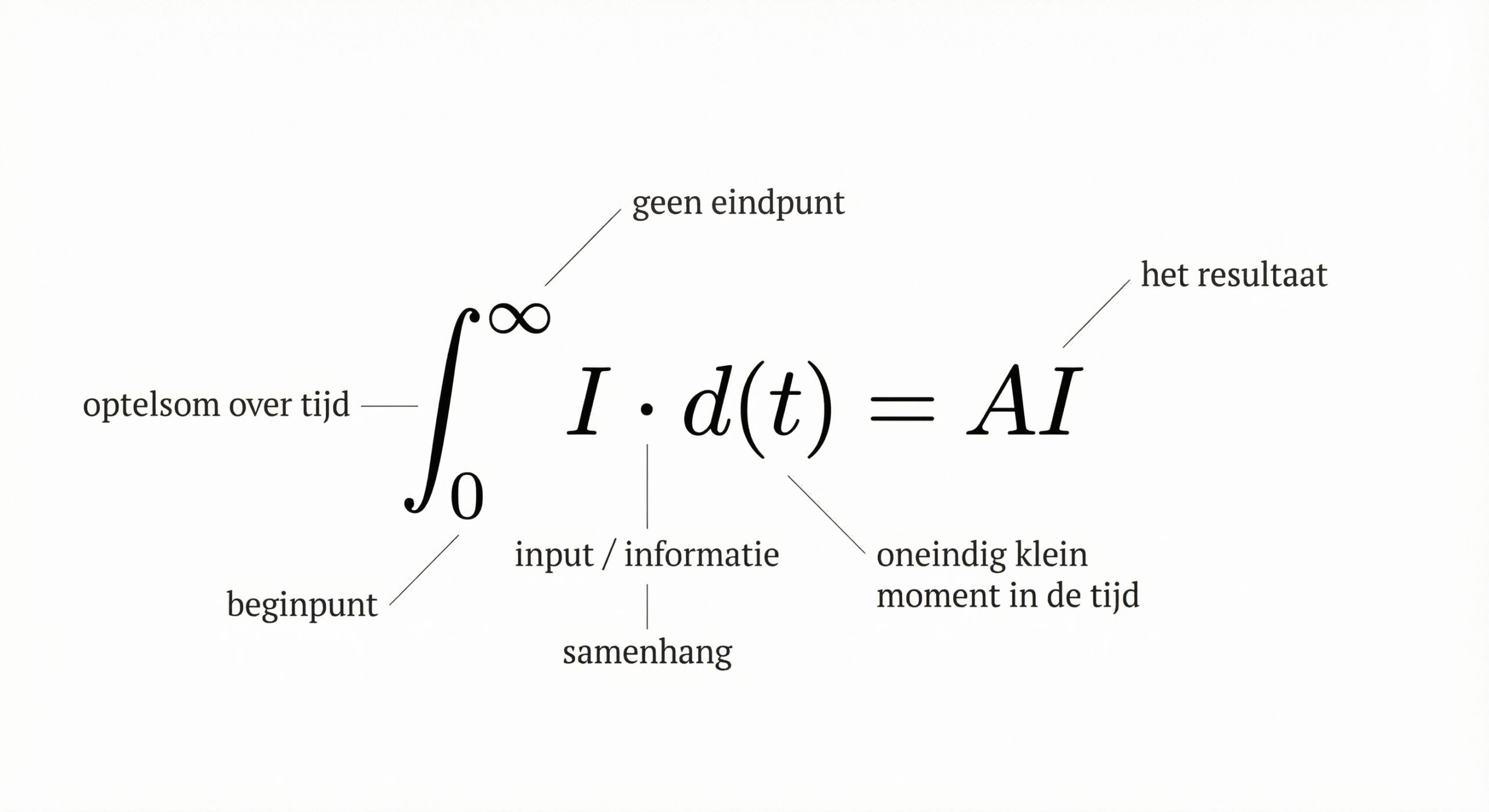
That formula describes what AI does: gathering information, endlessly, without boundaries. But you're not a sum. You're not a variable in a calculation. What you add isn't in that formula, because it can't be calculated. Your experience, your skills, your attitude. That's what the formula misses. And that's precisely what becomes your greatest asset.
After this you can move on to The paradox of infinite information, because then you've given the reader a compass: we're going to talk about what you add.
The paradox of infinite information
We're living in a peculiar era. Never before has so much knowledge been so easily accessible. You ask a question to an LLM and within seconds you have an answer that five years ago would have cost hours of research. Marketing strategies, legal concepts, medical information, technical manuals—it's all there for the taking.
It feels like a funfair where all the rides are free. Sounds fantastic, until you realise everyone's in the same bumper cars. The competitor who yesterday was still improvising a lot has today got access to exactly the same AI tools as you. The same templates. The same analyses. The same answers.
Here's the paradox. The more information becomes available, the less that information is worth. Think of LPs and CDs. They've long since disappeared too, except amongst a handful of people who still value them for nostalgic reasons. Lovely collector's items, but no longer relevant to the mainstream. The question is: do you want to be the vintage record player that people look at fondly? Or do you want to stay relevant?
If information becomes the great leveller, what makes you special?
The problem no one says out loud
You hear it everywhere. We're going to drown in AI content. Our jobs are being taken away. Soon we'll be able to do everything ourselves. That's complete nonsense, of course, but it does touch on something real. The fear isn't in the technology itself. The fear is in the question: if AI can do what I can do, why would anyone still choose me?
I see it daily in my practice. Entrepreneurs come to me with AI-generated positionings. Neatly worked out, all boxes ticked, theoretically sound. And yet something's not right. It's missing something. But what?
Recently I sat with an entrepreneur who'd had his entire strategy written by AI. Impressive document. Eighteen pages with audience analyses, brand values and communication guidelines. He asked me for feedback.
I asked him one question: Why did you start this business in the first place?
Silence.
The answer wasn't anywhere in those fifteen pages. AI had told him what he should be, not who he was.
That's the real problem. AI can gather, organise and present information. It can recognise patterns and generate content. But it doesn't understand what it makes. It has no why. Ask it the same question again in five minutes and the answer can be completely different. Not because it's thought it over, but because the statistical calculation just worked out differently.
Someone once called AI a stochastic parrot. Apt. It repeats patterns from everything it's seen, without understanding what it's saying.
The question that matters
If AI keeps getting better at delivering information, what's left for you? What can you add that a machine can't? Where does your value lie in a world where knowledge has become almost free?
This isn't a theoretical question. This is the question that determines whether you'll still be relevant in your field in five years' time.
The answer comes down to three letters: ESA
Let me introduce you to ESA. Not a person, but an acronym for the three things that AI completely lacks and that you have in abundance: Experience, Skills and Attitude.
Where A[i]dam fills the world with data, ESA brings understanding. It's the difference between knowing and understanding. Between having information and being able to do something with it.
Experience is your built-in radar
Experience is gut feeling. It's knowing without being able to explain it immediately. Born from situations you've been through. From conversations that had tension. From projects that went off the rails or unexpectedly worked. Experience leaves traces. Scars from failures, but also the confidence that emerges after a breakthrough.
AI has never felt the tension of a difficult client conversation. It hasn't experienced how a project slowly gets out of hand or unexpectedly pivots. It knows no scars from mistakes and no joy from breakthroughs. That's why AI can know a lot, but feel nothing.
In my work I notice this weekly. An entrepreneur says: I want to grow. But by now I often hear something quite different in the back of my mind. Sometimes what someone actually means is I want peace or I'm done with this or I want to prove I can do it. You don't read that in the data. You sense it. It's that intuition that warns you before you can name why.
That intuition isn't mystical. It's compressed experience. Dozens of situations you've been through, stored consciously and unconsciously, that are consulted in a fraction of a second when you encounter a new situation. AI can't build that database, because AI experiences nothing.
Skills are more than just knowing
Skills are what you can apply in practice. They're learnt abilities that you deploy to make, analyse or solve something. They emerge through practice, repetition and experience. Skills are visible in behaviour and results, but they only really work well when the underlying attitude is right.
AI can list thousands of marketing strategies, but has never executed one. It can suggest a conversation structure, but can't sense when you need to deviate from the script. It can generate a brand strategy, but can't judge which model fits this specific entrepreneur, with this history, in this market.
Skills are about doing, not about knowing. Asking the right questions. Really listening, not just hearing. Judging, selecting, correcting. The ability to filter AI output through your own expertise and determine what's usable and what isn't.
This is perhaps the most underestimated skill of this moment: being able to critically evaluate what AI produces. Because AI doesn't lie, but it does fantasise. It presents nonsense with the same certainty as facts. Only someone with real skills can see the difference.
Attitude is the engine behind everything
Let me explain this word for a moment. Attitude is your inner stance towards learning, change and the unknown. It's curiosity. Daring to deviate from well-trodden paths. Wanting to understand rather than just know. The willingness to step outside your comfort zone and keep learning.
This is where it gets personal. Attitude is also curiosity. It's daring to deviate from well-trodden paths. Wanting to understand rather than just know. The willingness to step outside your comfort zone and keep learning.
AI has no drive, no direction, no course of its own. It optimises for what you ask, not for what you need. It has no opinion about where you should be going and certainly no passion to help you get there.
Your attitude determines how you use information. Two people can receive exactly the same AI output and do completely different things with it. One copies and pastes. The other uses it as a springboard for their own thinking. The difference isn't in the tool, but in the user.
When understanding becomes knowledge
Here's the core. As AI gets better and better at delivering information, value shifts from knowing to understanding.

Information you can look up. Understanding you have to build.
Take strategy for your business. AI can serve up twenty positioning models in seconds. Porter's Five Forces, the Golden Circle, the Brand Key Model, you name it. The information is complete. But which model suits this specific situation? When does a model actually limit you? Which combination of models gives the best insight?
That requires someone who's been through similar journeys. Who recognises the nuances. Who understands the context. Someone who knows that models are tools, not answers.
That's not information processing. That's knowledge. And knowledge only emerges when information is combined with EVA.
Who'll still be in demand?
Market value is shifting. Not away from knowledge, but towards a specific kind of knowledge. In conversations with entrepreneurs I keep seeing the same patterns. I see four types of people who thrive in this new landscape. Not because they're cleverer than AI, but because they combine knowledge, skills, attitude and experience in ways AI can't.
The connector is someone with a broad view who sees connections across disciplines. Where AI treats categories as separate, you see the unexpected links. You combine insights from marketing with psychology, from design with strategy, from technology with human behaviour. Those combinations are exactly where the interesting solutions lie.
The context thinker sees the whole ecosystem. Not just the problem, but also the stakeholders, the unspoken interests, the political sensitivities. You understand that a solution only works if the environment moves with it. AI sees the question; you see the playing field.
The translator bridges what the machine produces and what people need. You can translate complex AI output into comprehensible insights. You make it concrete, applicable, human. In a world full of information noise, that's a rare and valuable gift.
The innovator has not just knowledge and skill, but also will. The attitude to work on questions that have no standard answer. You seek out the edges, experiment, dare to fail. Where AI optimises for the known, you explore the unknown.
Do you recognise yourself in one or more of these profiles? Then you've got a head start.
How to build your own EVA
The theory is clear. But how do you translate this into practice? Five concrete steps I apply myself and advise my clients to take.
1. Document your experiences
Not everything you go through automatically becomes experience you can build on. Patterns only become visible when you capture them. Take time weekly to reflect. What did I learn this week? Which situation surprised me? Where did my intuition kick in? Write it down in a notebook or journal.
I do this myself through almost daily reflections. Brief notes about projects, conversations, insights. After a year you have a treasure trove of material. After ten years you have a personal database AI can't match.
2. Ask AI better questions
The quality of your AI output depends on the quality of your input. Use your experience to ask the right questions. Not write a marketing plan, but which three assumptions in this marketing plan are most risky for a B2B service provider in a saturated market?
Your EVA determines the value of the AI output. The better you understand the context, the more precisely you can ask, the more useful the answer.
3. Exercise your judgement
Have AI generate three variants and consciously choose one. Name for yourself why you're choosing it. Train yourself in evaluating output. Where does something not ring true? What's missing? Which nuance is absent?
Your critical faculty is a skill that sharpens with use. Every time you consciously judge AI output, you train your own expertise.
4. Seek out the edges
You don't develop attitude by staying in your comfort zone. Take on projects that challenge you. Talk to people outside your field. Read outside your own bubble.
Every uncomfortable situation is a chance to enrich your EVA. The projects I've learnt most from were the projects I was least certain about beforehand.
5. Combine human and machine consciously
Use AI for what it does well: first drafts, research, generating variations, automating dull work. But always add your own layer. Your anecdotes, your cases, your perspective, your doubts.
The combination of AI efficiency and human depth is more powerful than either alone. It's not either/or. It's both/and, but with you at the wheel.
Your humanity is your brand
As an entrepreneur or professional, your EVA — your humanity — is precisely what sets you apart. It's the reason clients choose you and not the competitor using the same tools. That's also exactly what distinguishes a strong brand identity.
Your experience with dozens of similar projects. Your skill in questioning down to the core. Your attitude of continuing to develop yourself. You can't outsource that to an AI. You have to build it yourself. A bit every day.
The question isn't whether you're going to use AI. Of course you are. The question is whether alongside that you keep investing in your own EVA. Whether you keep gaining experiences that feed your intuition. Whether you keep sharpening your skills. Whether you maintain the attitude to keep learning.
AI makes information cheap. That makes your EVA all the more valuable.
The future isn't human versus machine. The future is human with machine, where your EVA determines how much value that combination delivers. A[i]dam had the book. Eva had the mirror. You need both, but without self-knowledge all the knowledge in the world is nothing more than data.
Conclusion
Want to discover your EVA and turn it into a brand that sticks? In the Brand Direction Programme you build the foundation for your business in three months. No endless plans. Just concrete steps you can take straight away. Curious? Look at my approach or email [email protected].