Brand strategy and AI: a combination that's increasingly demanding on business owners. There are two types of business owners dealing with AI at the moment. The first group is frightened. They read the predictions, watch the demos and wonder how long it'll be before their work becomes redundant. The second group uses AI to work faster, produce more and operate more cheaply. Both are missing something.
Because the real question isn't what AI can take over. The real question is: what makes your brand unassailable? And that's a question no algorithm will answer for you, however clever it may be.
AI can generate a brand strategy. What it cannot do is install the conviction that brings a brand to life. That requires a conversation, honesty, someone who dares to probe deeper. And that's precisely the difference between a brand that works on paper and a brand that works in your head.
Summary
AI can help you build a brand strategy, but cannot install the conviction that brings a brand to life. That requires a real conversation, honesty and someone who dares to probe deeper. Your distinctive capability lies precisely where AI structurally falls short: in human contact, recognition and the courage to make sharp choices.
A brand is not a document
Ask ten business owners about their brand strategy and nine will point to a file on their computer. A PDF with colours, typefaces, a tagline and perhaps a brand personality they once established with an agency. Tidy. Useful. And yet often dead.
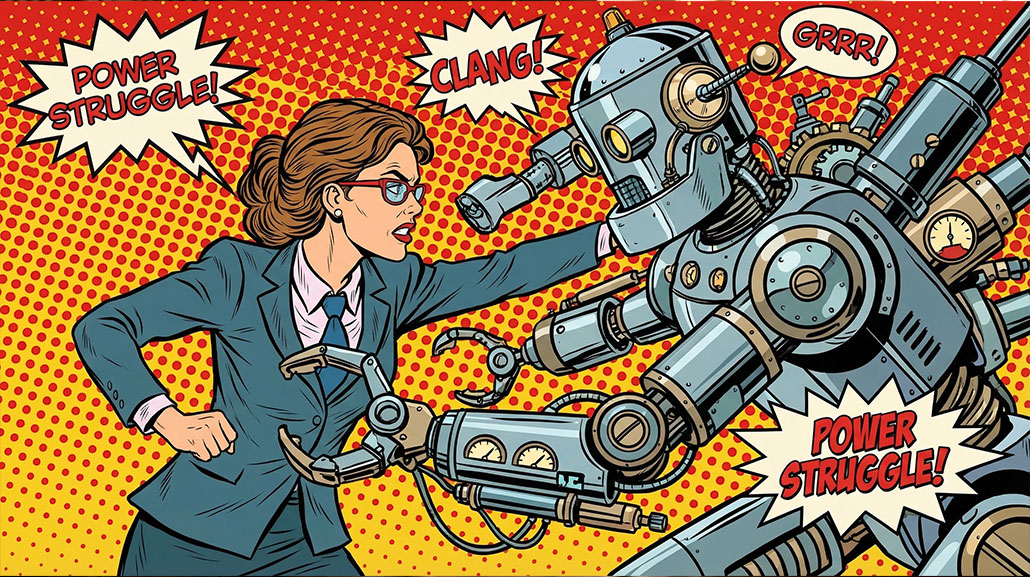
Is there a public debate about the battle between human and machine? Not on a very large scale. Among the thinkers, yes, not among the doers.
Because a brand doesn't live in a document. It lives in the way you talk about your work at a networking drinks. In the choices you make when a client asks for something outside the agreement. In the copy you write when nobody's watching. That's where the real brand is. And you can't import or generate that.
AI is actually very good at this: building structures, formulating positioning statements, organising brand values. Give it the right input and within ten minutes it'll deliver you a brand document that looks professional. That's not a threat. That's a tool.
The problem isn't the output. The problem is the input. Because most business owners don't know exactly what they should enter themselves. Not because they don't know their trade, but because they're too close to their own story.
The business owner who knew what he wanted, but didn't believe it himself
A business owner, let's call him 'Kees' in this context, had started ten years ago as an independent adviser in the construction sector. Good at his trade, solid reputation, full diary. But his brand, his website, his presentation, none of it felt right anymore. It felt like a suit he'd bought five years ago and had since shrunk three sizes.
He'd noticed it himself. He'd already had a new website made. New photographs. New copy. But the result disappointed him without him being able to say exactly why.
When we talked, it quickly became clear. Kees had developed over recent years from operational adviser to strategic sparring partner. He'd long since stopped working at project level. He sat at the table with directors. He thought along on organisational issues that lay far beyond his original field. But his brand still told the story from ten years ago.
The insight was already there. It was already in him. What was missing was the confirmation that he was allowed to say it. That it wasn't arrogant, but that it was true. That's the kind of conversation an LLM doesn't have with you.
Brand strategy and AI: what people can do
AI is very good at analysing, summarising, structuring and formulating. It can compare competitors, describe target audiences and sketch positioning options. It can help you arrive more quickly at a first version of virtually any document. But there are things that are fundamentally human in a brand process. Things that require a good conversation, not a good prompt.
The first is honesty. Many business owners have a gap between what they say they do and what they actually do. Not out of dishonesty, but out of habit. They describe their work as they described it five years ago, because that's the language they're used to. An LLM(AI) takes over that description. A good conversation partner asks: hang on, is that still what you do now?

Kick AI off your patch if it becomes your holy grail.
The second is courage. Making a brand sharper also means making choices. Letting go of target audiences. Scrapping services. Taking a position that isn't for everyone. That's uncomfortable. AI gives you options. But doesn't tell you which option suits you and why you must dare to let the others go.
The third is recognition. The moment when someone says: 'yes, this is me, this is how I want to be seen', that moment isn't a rational conclusion. It's a feeling. And that feeling doesn't arise from reading a document. It arises in a conversation where someone gives your own words back to you and asks: is this what you mean?
Get better at what AI cannot do
This is the advice I give to everyone who asks me how they remain relevant in a world full of AI tools. That's certainly the case if you act as though AI doesn't exist. But not if you use AI for everything that speeds up your operating system. But the most important thing in everything is that you very consciously invest time in the things that require human contact. That even cry out for it.

People who meet and talk to each other: worth 1000x more than the AI bubble.
In brand strategy, that's the relationship. The client who knows you understand his story, not just his brief. The business owner who comes back to you, because the previous conversation took him further than any report. The client who rings you because he can't work something out and knows you'll ask the right question. That's not soft. That's distinctive capability. And it's precisely the terrain where AI structurally falls short.
An AI can tell you that your brand needs to be more consistent. It cannot sense when a business owner is making himself smaller than he is. It can generate positioning options. It cannot feel which choice truly suits someone.
For teams and organisations there's an additional layer. Not only must you be able to articulate your brand, but so must everyone who communicates on your behalf. How you structurally embed that as your organisation grows requires its own approach.
What makes the Brand Direction Programme different
The Brand Direction Programme is there for business owners who are in exactly the same situation as Kees. You know your brand doesn't feel right anymore. You sense it, but you can't yet articulate it sharply. And you need someone who not only thinks along, but also probes deeper.
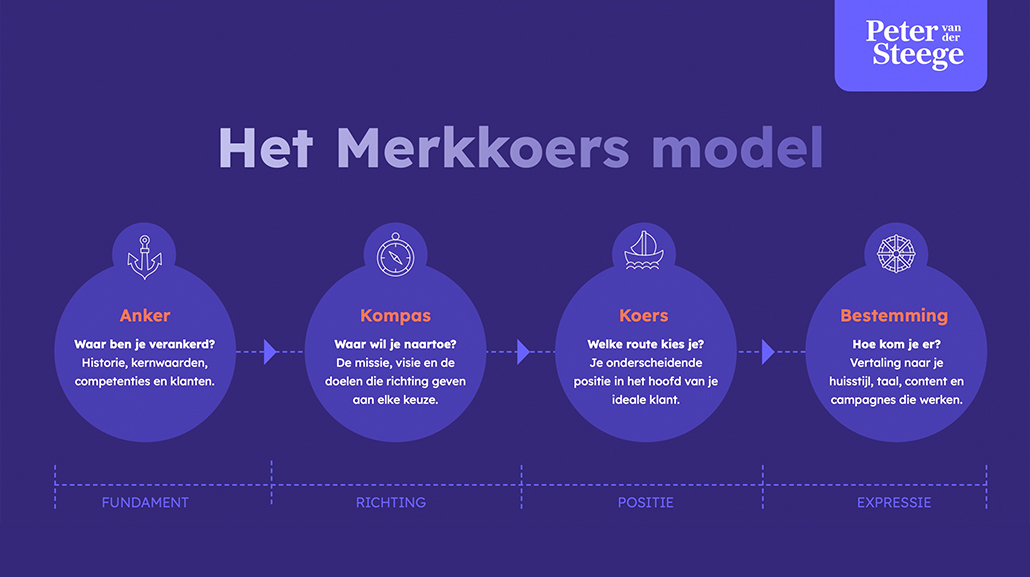
This programme isn't about producing a standard brand book. Nor a document you then put in a drawer.
This is a programme where at the end you know what your brand is, why it's right, and how you express it. Not because I've invented it for you, but because we've excavated it together. From your story, your experience, your convictions. That's the work you cannot outsource to a tool.
In short
Brand strategy and AI are not opponents. AI strengthens what's already there — but only if that foundation exists. International sources such as Harvard Business Review confirm it: brands with a sharp identity grow faster than generic competitors. Read more about brand identity or look at my approach.
Curious whether this programme suits you?
Send me an email. No form, no funnel, no sales conversation. Just an email. You'll receive back from me all the information about the Brand Direction Programme, including what it entails, who it's intended for, and what it costs.
Send an email to [email protected]
And if, after reading this information, you think: this isn't for me, at least you'll have a clear picture of what brand strategy at this level involves. That alone is worthwhile.