Brand value is the feeling that people get from your brand — and you build that feeling consciously. There are those moments when you look at your own brand and think: this is right. The form, the tone, the photography, even the mission on the about-us page is quite well worded. Everything feels in order.
Yet it remains quiet. No new enquiries. No warm leads. No conversations in which someone says: You're exactly who we're looking for.
That's frustrating. Especially when you know how much attention you've paid to your positioning. You've thought about what you do, how you work, who your client is and why your brand matters. But in practice it turns out: that story doesn't stick. People look, but don't choose. They scroll, but don't call.
What you're missing then isn't strategy, isn't style and isn't intention either.
What you're missing is brand value.
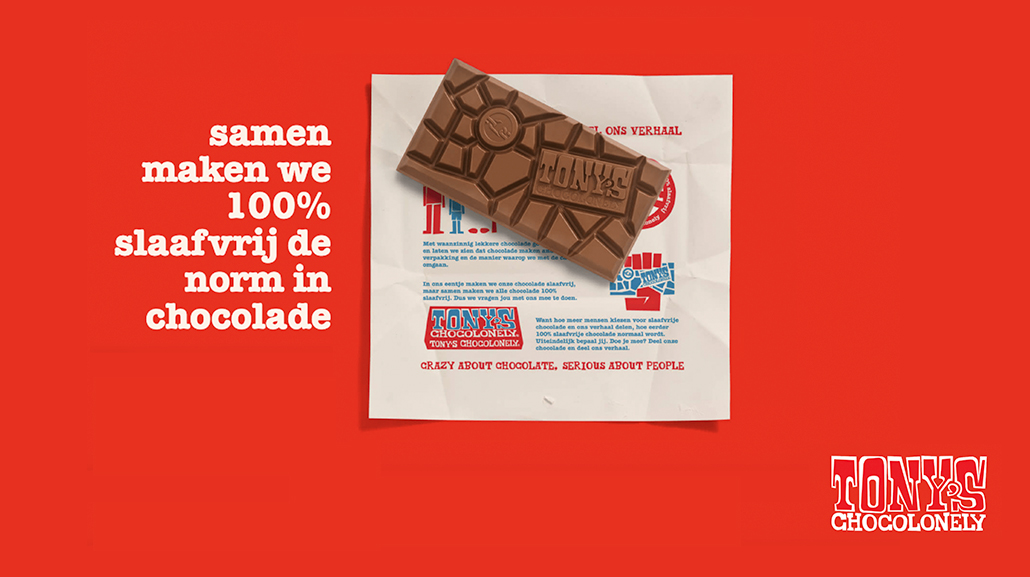
Tony's Chocolonely has created an indelible brand value.
Brand value is the meaning that people assign to your brand, before they become a client. It's the mental place you occupy in their head. That needs to be solid.
But with many entrepreneurs that place turns out to be soft, vague or entirely absent. They're visible, but not distinctive. Recognisable, but not relevant. Or even more difficult: they communicate perfectly, but aren't believed.
And then nothing works anymore. Then you can blog, advertise or fill a content calendar until you're blue in the face; it won't make any difference as long as your brand doesn't represent real value in the eyes of your target audience.
Why brand value doesn't arise by itself
The misunderstanding often lies in the assumption that a good story sticks by itself. You think: if I've got my mission sharp and explain my services well, then people will understand by themselves why they should come to me.
But it doesn't work that way. In a market full of stimuli and competition, brand value is something you have to build, shape and hold onto. It doesn't arise spontaneously because you're good at your profession. And it doesn't become stronger if you simply start posting more often or have your house style redesigned.
In fact: many entrepreneurs invest in the wrong order. They renew their website, have a new logo made or launch a campaign, without first being clear about what their brand really means to their target audience.
The result? A beautiful exterior without an interior. Or a brand story that's technically correct, but does nothing emotionally.
You don't move people with completeness, but with meaning.
Not with logic, but with recognition.
Not with a list of what you do, but with a promise that's tangible.
Without brand value everything remains fleeting. Then you have a brand that exists, but doesn't really enter anywhere.
And if you don't enter anywhere, you don't lose anything either. No attention. No trust. No turnover.
What does brand value have to do with how people make choices?
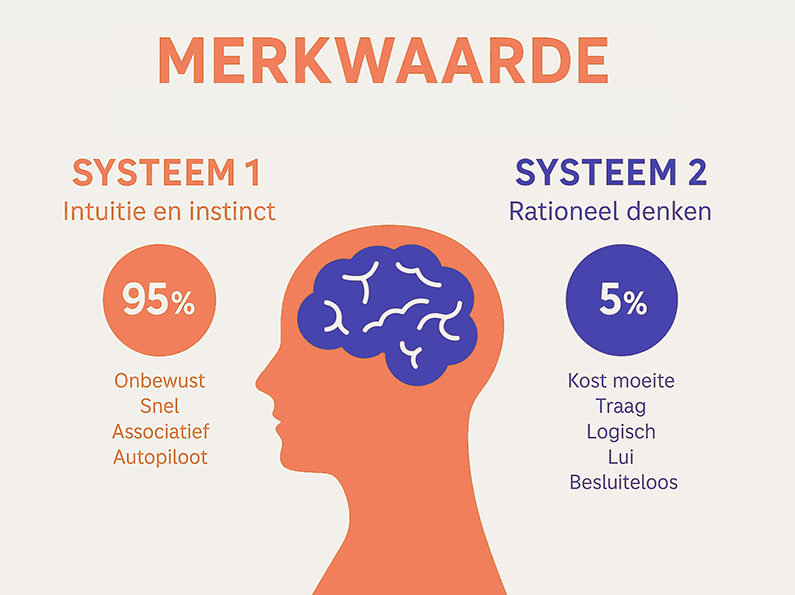
To understand that properly, we'll briefly dive into the psychology of decision-making. Nobel Prize winner Daniel Kahneman introduced in his book 'Thinking, Fast and Slow' two ways in which people think: system 1 and system 2.
System 1 is fast, automatic, intuitive and emotional. It's the form of thinking with which you immediately recognise whether something feels familiar. Think of a brand that you recognise at a glance and that you click on without thinking.
System 2 is slow, conscious, rational and analytical. You use this system when you have to think about something, make considerations or compare options.
If your brand is strong, so if it has brand value; you activate system 1. People then choose faster, with more confidence and without much doubt. You become the obvious choice.
But if your brand is vague, unclear or interchangeable, then people have to start thinking. You force them into system 2, where they compare, weigh up alternatives and possibly choose someone else.
In short: strong brands save your client mental effort. And that makes the difference.
Source: Daniel Kahneman (2011), Thinking, Fast and Slow
Work with these three tips on positive brand associations and increase your brand value.
1. Strengthen your brand value yourself first
So ensure that your brand stands out and sticks with your target audience. Because recognisable brand elements activate brand knowledge and accelerate recognition (system 1).
Map out which brand elements you currently have (logo, colour use, typography, tone of voice, slogan, jingle, packaging form, ambassador etc.)
Check whether these elements are used consistently across all your communication channels (website, socials, quotations, presentation, email signature, etc.)
Ensure that your brand elements are visually and verbally distinctive — not run-of-the-mill designs or hollow slogans
Test your brand elements in practice: show them to 5 outsiders and ask which associations they evoke. Do these correspond with what you want to convey?
2. Build positive brand experiences
Make your brand automatically evoke positive thoughts or feelings.
I believe that every touchpoint with your brand should evoke positive associations that stick.
Analyse the most important contact moments with your client (first acquaintance, quotation, delivery, aftersales).
Map out per moment how you make an impression and whether that's positive, distinctive and credible.
Use storytelling to charge your brand with human, meaningful content (think of client stories, visions, behind-the-scenes moments).
Monitor and actively collect positive client feedback and testimonials and use these on your website or socials.
Anchor the core of your brand story in every piece of content you create, so that every expression 'feels' like you.
3. Shift your brand from system 2 to system 1
Ensure that your brand isn't only recognised, but also automatically chosen. People make most choices unconsciously; brand value makes you the preferred option.
Ensure that your brand is always present in places where your target audience orientates itself (top of mind begins with top of search & top of feed).
Repeat your message without becoming boring: use variation in form, but keep the core identical.
Use fixed formats for content (such as columns, recognisable titles, recurring formats) to strengthen mental recognition.
Link your brand to an emotion or feeling: what do you want people to think of when they see your name?
Minimise choice stress: ensure one clear proposition per campaign or per page, without overload of options.
How you do build brand value
Brand value doesn't arise by itself. It's not a by-product of quality or experience, but the result of conscious choices. Of thinking about what you do, why you do it and especially: how you make that visible and tangible for the outside world.
Anyone who thinks that brand value equals having a good story is mistaken. Many brands have a story, but that's not the same as meaning. Meaning only arises when your story is also experienced, recognised and remembered.
That requires more than content. It requires direction, consistency and character. A brand that dares to make choices; in style, in tone, in target audience.
A brand that doesn't try to appeal to everyone, but rather to someone very specific.
For entrepreneurs who work with a team or larger organisation, another dimension is added here: how you safeguard that consistency as more people carry your brand. That's not a marketing question, but a structural question.
Good brand value can't be captured in loose terms like reliability, client focus or innovation. Those are words that everyone uses and therefore no longer move anyone. What you need is a message that doesn't only work for yourself, but also reaches the other person.
For that you must dare to look inwards, before you step outwards. Because only when you know exactly what you stand for and what you want to mean, can you build a brand that's more than a logo or a house style. Then value is created.
Not only for you, but especially for the people who will carry, pass on and trust your brand.
In short: this is how you build brand value
Brand value doesn't arise by itself. It's the result of consistent choices, a sharp identity and the courage to choose who you are. Read more about brand identity or view my approach.
And now?
Anyone who sees brand value as something that grows by itself, underestimates the work that precedes it. It's not a luxury, not a side issue, and certainly not a sum of loose marketing tools.
It's the quiet force beneath everything you show and say. When that force is missing, your brand isn't remembered. No matter how good you are.
Want to know more about how brand value really works, and how to anchor it firmly in your positioning?
Then read on at my page about personal branding.
There I explain how to strengthen your brand from within and make it visible in a way that sticks.
Good luck with the tips!