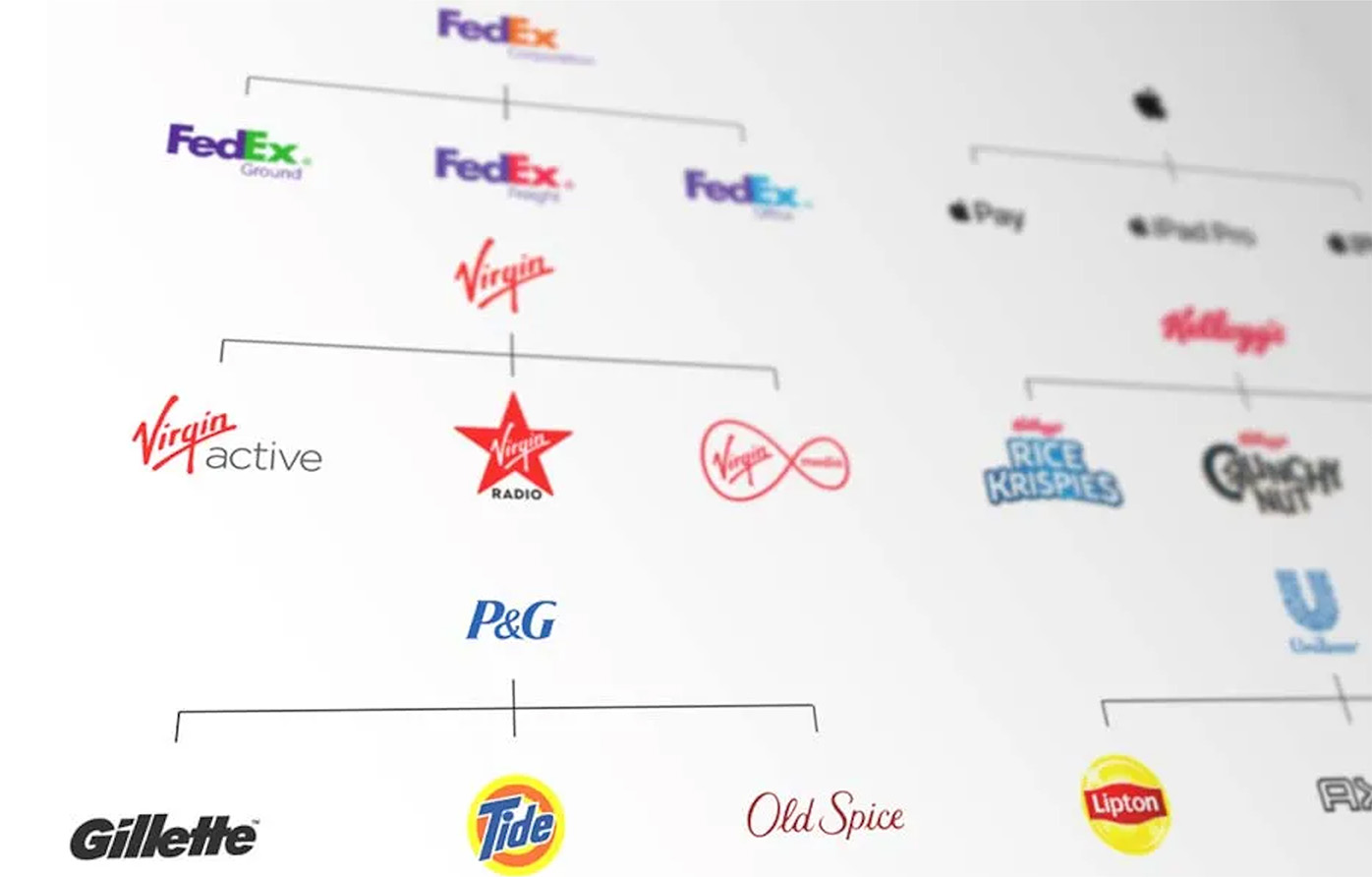
The concept of brand architecture under the microscope
I see it regularly: choosing a brand architecture isn't simple. I speak to companies launching a second service, or companies merging, and suddenly nobody's on the same page anymore. Customers don't understand how everything belongs together. Employees give contradictory answers. The marketing budget gets fragmented across brands that cannibalise each other.

What's usually the root of the problem? No clear brand architecture.
The brand architecture determines whether your brand is comprehensible in ten seconds or a fruit bowl full of riddles. It also determines how much money you waste on marketing, and whether your next step delivers growth or chaos.
In recent years I've seen that entrepreneurs don't need these two things: more brands and more complexity. They need clarity. And that begins with the right architecture.
Summary
There are four classic brand architecture models that still set the standard. But I also describe a fifth model that isn't so obvious. Don't choose your model based on what's convenient internally, but based on how your customers see it. Modern thinking doesn't mean reinventing everything; it means deploying the classic models more cleverly with an eye for speed and clarity.
Many companies don't choose. They drift. What a waste.
Why does brand architecture play a bigger role than you think?
Brand architecture is, simply put, the way to determine how your brands, sub-brands and services relate to each other. How customers understand that Product A belongs to Brand X and Product B is something completely different.
But here's the bird's-eye view; many companies think that brand architecture is a luxury for big players. Nonsense. For SMEs it's actually crucial.
Why? Because your budget is often limited. Every euro of marketing must work. Every customer must grasp what you do in one glance. Every new step must build on what you've already established, not detract from it.
Think of Nike. Clearly a monolithic brand (That's everything under Nike), but with sub-brands like Nike ACG for outdoor and Nike SB for skateboarding. Customers understand it immediately. It feels logical. Nike saves marketing budget, because everything builds on a central reputation. At the same time specialists have room for their own story.
That's brand architecture. Strategic clarity. Nothing more, nothing less.
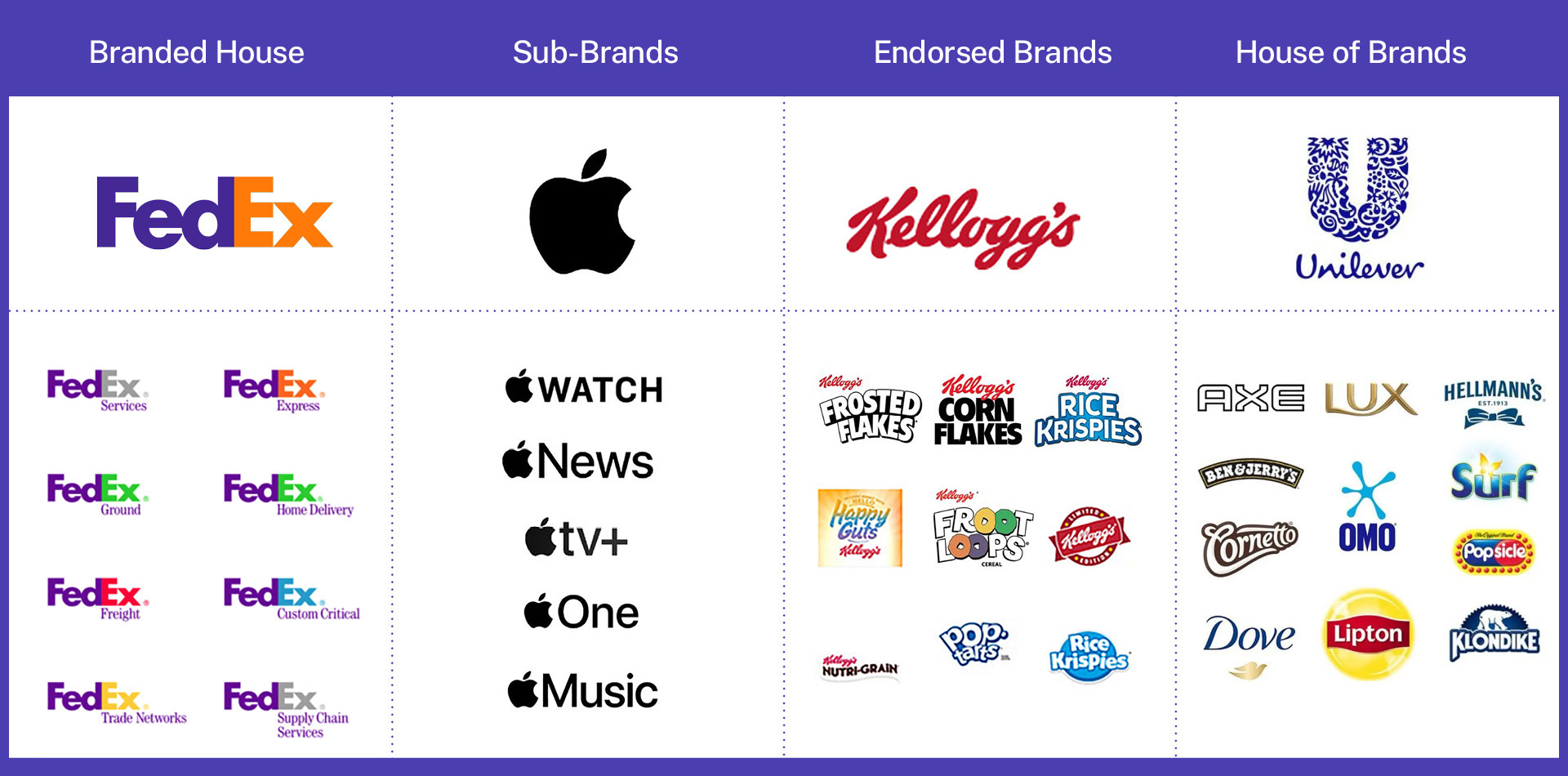
The 4 brand architecture models in 1 diagram.
The four classic models. The standard that still stands
The foundation for brand architecture was laid decades ago. We're talking here about how larger brands like Nike, Apple, Unilever and Google build their portfolios. But what works for them can deliver you just as much as an entrepreneur. These four models are like building blocks; you can use them purely or combine them. A branded house architecture works well for strong brands. In contrast, a house of brands is useful when the brands must remain independent.
They're not dogma, by the way; they're guidelines. I'll explain them here first.
Branded House
Everything under one strong name
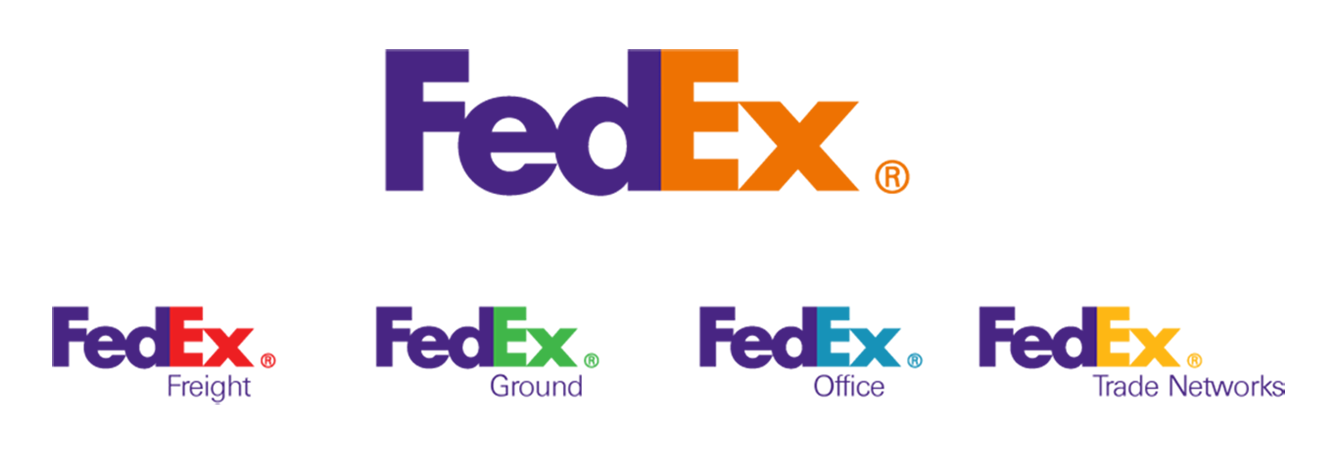
The simplest model from FedEx. Still the textbook example of a Branded House structure.
This is the simplest model. All products, services and target groups under one brand. FedEx does it. Samsung does it. You have one strong reputation; you carry it everywhere.
The advantage is clear; you build one strong reputation that lifts everything. Every euro of marketing pulls all services up. New services immediately ride on the name recognition. A customer who already knows you through one service only needs to take a small step to your other offering.
The disadvantage of Branded House? The brand is vulnerable. One major misstep and everything suffers. This model works perfectly if your target groups are the same or very close together.
Choose this model if you have one clear target group, one core promise, and you want to focus everything on one brand. Budget is small, but focus is large. A coach with three forms of coaching (one-on-one, groups, online) would fit perfectly here. It's all about the same expertise; the delivery form differs, not the core.
House of Brands
Each brand its own freedom
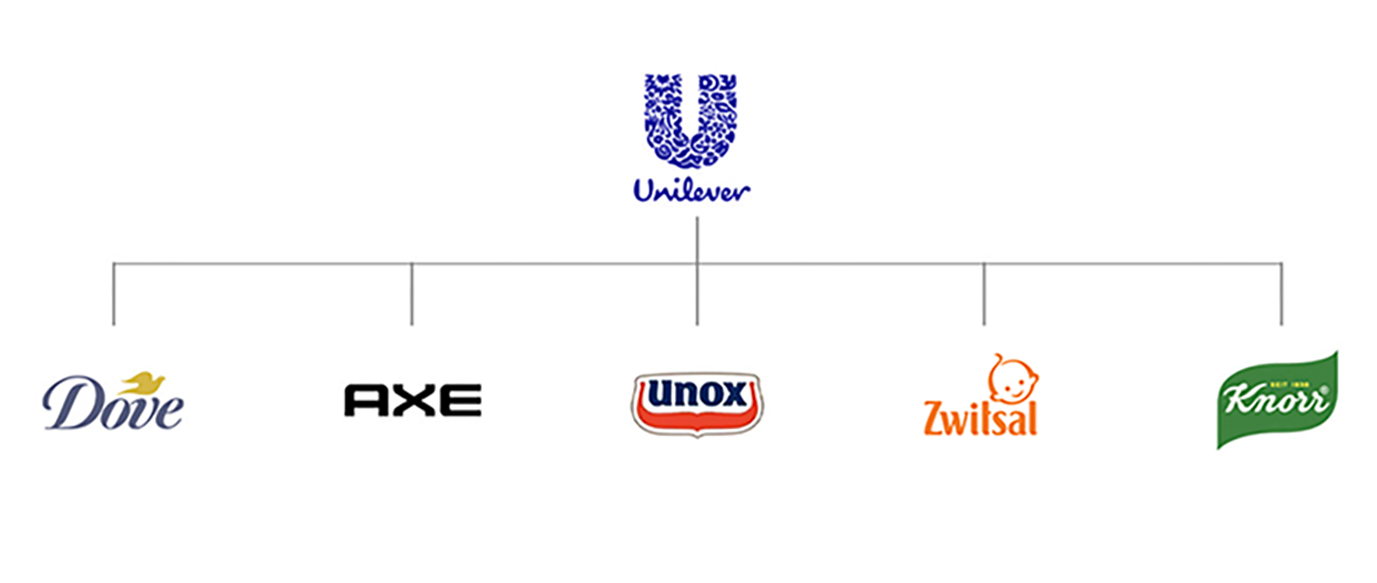
Unilever is the cliché example of House of Brands.
Now the opposite. Each brand stands apart. Completely different identities. Completely different target groups. Unilever is the classic example: Dove, Lipton, Calvé, Axe. You don't even know they belong to the same parent. That's the intention.
The advantage; you can serve micro-segments without pulling one brand out of balance. Reputation damage to one brand doesn't affect the other. P&G does this; Gillette, Olay, Pantene, Crest. Each brand feels completely independent.
The disadvantage? Huge budget required. Each brand demands its own strategy, its own marketing, its own identity, its own tone of voice. This model is for big players with marketing teams that can handle it.
Only choose this if you truly have different target groups with completely different needs. And be honest with yourself about whether you have that marketing budget. A solo entrepreneur with this model ends in chaos.
Sub-Brands
The strong brand with specialists
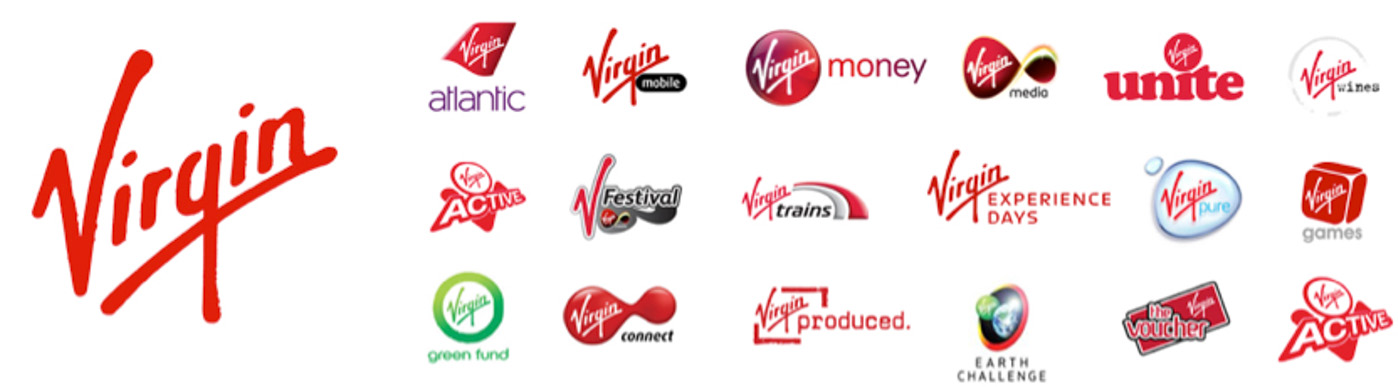
Virgin is the main anchor. But the Sub-Brands are developed through.
Here the master brand still works as anchor, but you add sub-brands with their own signature. Nike ACG (outdoor), Nike SB (skateboarding). Sony Walkman, Sony PlayStation. Virgin Mobile, Virgin Airlines. The best of both worlds; reputation of the brand plus freedom for specialisation.
The core characteristic; the parent brand gives you credibility. The sub-brand gives you specialisation.
This model demands balance. Not too many sub-brands (that becomes chaos) and not too few (you waste potential). FedEx does it well with FedEx Express, FedEx Ground and FedEx Freight. Each serves a different segment, but FedEx is the anchor.
This is interesting if you have two to four services that are very different, but still speak to your core expertise: A brand with sub-brands for LinkedIn Branding and Visual Identity works perfectly. It feels specialised without customers seeing it as two separate companies.
Endorsed Brands
The subtle support of the parent brand
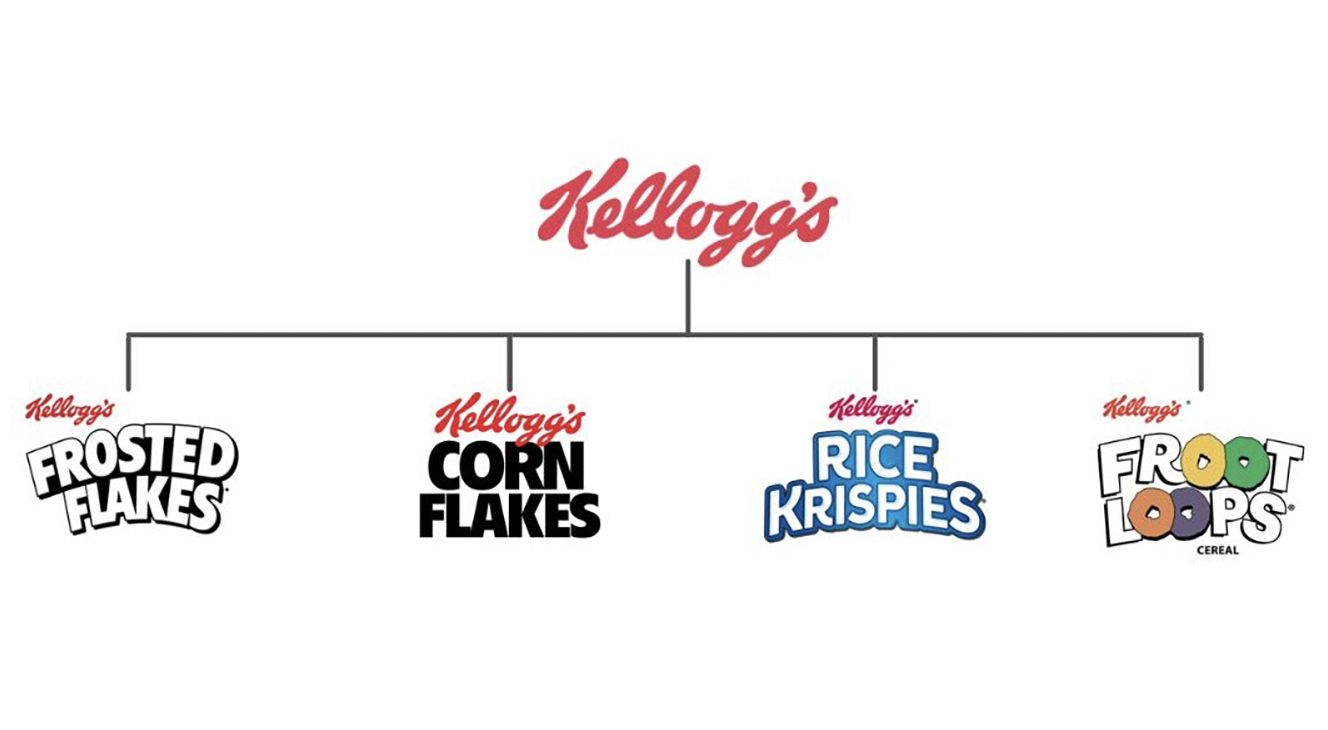
Kellogg's works entirely with the Endorsed Brands model
The brand stands small in the background. Adds credibility without dominating. Nespresso is owned by Nestlé, but Nestlé stands small on the label. Fairfield and Residence Inn belong to Marriott, but feel like their own brands. Luxury brands do this a lot; the parent brand adds prestige without visibly dominating.
This model demands finesse. The parent brand must be strong enough to support sub-brands without overshadowing them. Too little support and the sub-brand doesn't get enough credibility. Too much support and the sub-brand disappears into the parent brand.
For you; this works if you have one strong name, but want to launch specialised services that need to play their own game. A trainer with name recognition who launches an online academy can use Endorsed Brand perfectly. The trainer gives credibility; the academy plays its own game.
Hybrid branding; when none of the four models feels quite right
What to do when you're between categories
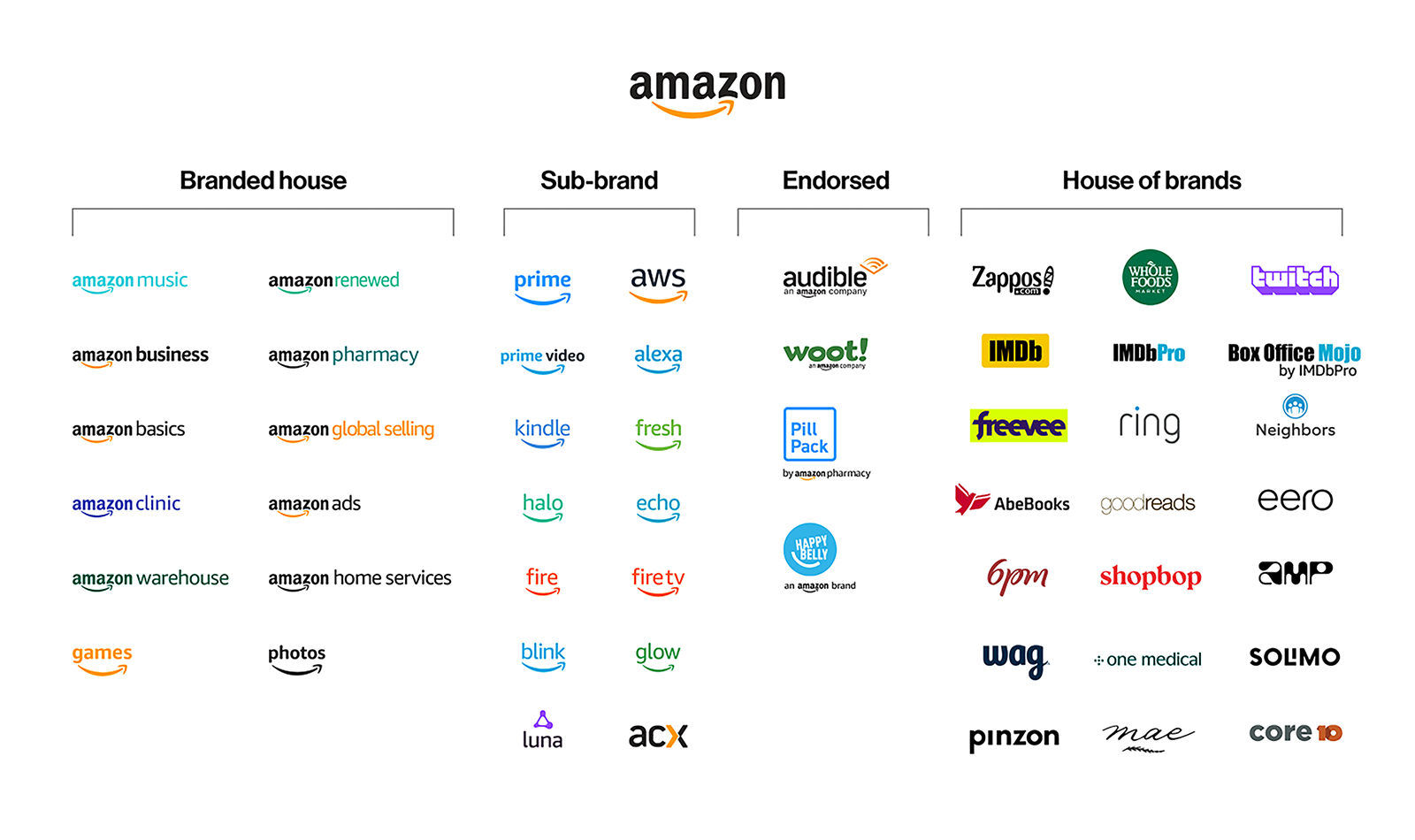
Amazon works with a hybrid brand architecture.
So far, you've seen four pure models. But the reality of many growing companies looks different. They start with Branded House, but grow towards Sub-Brands. Or they start with a clear model and suddenly notice the market demands something else. What then?
They don't feel at home in any one of them. They have a foot in two or three models at once.
Welcome to hybrid branding. The model that Amazon perfected.
Look at Amazon itself. It's not pure. It's not one thing. Amazon doesn't simply make everything under the Amazon name. They have Prime, AWS, Kindle, Audible, Alexa. Some sit under the parent brand as Sub-Brand. Others feel like their own brands (House of Brands). Still others are endorsed; you know full well they're from Amazon, but they play their own game.
This isn't chaos. This is strategy with flexibility.
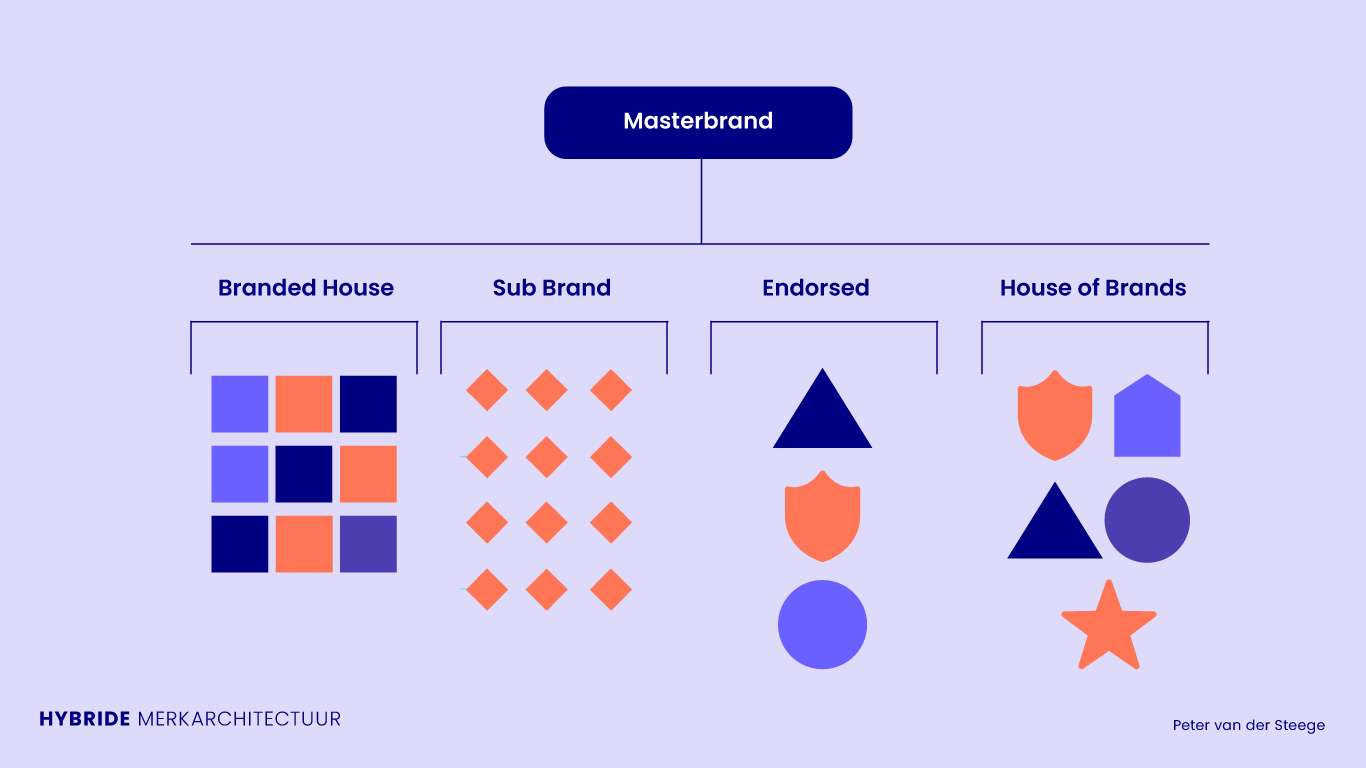
The Hybrid brand architecture in diagram form.
How does the hybrid model work?
You have a strong masterbrand (think of Amazon itself). That's the trust; the anchor. Beneath it you build different architectures, depending on what the market demands. Some services feel like one family (Sub-Brands). Others are deliberately separate (House of Brands). And still others work best with subtle endorsement.
Your model differs per service; but the total picture feels logical.
Why hybrid branding is clever for companies in motion
Sub-Brands demands clarity. House of Brands demands budget. Endorsed Brands demands finesse. Hybrid branding demands one thing: intelligence at the moment of choice.
Amazon does this almost instantaneously. AWS is a technical service; that demands a strong Sub-Brand. Prime is a loyalty benefit; that feels like core business. Alexa is consumer tech; endorsement works better there. Twitch (owned by Amazon) plays completely as its own brand.
Each of them could have failed if it had been given the same architecture. But Amazon adapted the strategy to what the customer needed.
This flexibility is gold for companies that are growing and pivoting. Markets change. A model that's perfect today can pinch in nine months' time. Hybrid architecture gives you room to pivot without overturning everything.
A brand architecture based on your internal structure?
Here's the big problem. You have a finance department, an HR service and a training component. So you create three brands. Logical from the inside. Completely confusing from the outside.
Customers don't see that. Customers see; why are you offering this; why that; how does it fit together? And if the answer is internally convenient, you're lost.
The rule is golden: organise your brand architecture around your customer, not around your organisational charts. What does your customer see? What can they understand? What feels logical?
This also gives you a strong warning. Many companies that launch dynamic portfolios actually do so because their internal structure changed, not because their customers have a need for something different. That's working backwards. Wrong.
What has changed in the meantime and what should you be alert to?
The four models are still the core. But the world around them has changed. Markets move faster. Customers expect more flexibility. Data provides insights we didn't have twenty years ago. This demands different thinking, not entirely new models.
Trend 1 – Simplification wins over complexity
Major giants like Unilever, Procter & Gamble and Coca-Cola are consolidating their portfolios. They're scrapping sub-brands. They're streamlining. In 2024 Lippincott said this is called the wave of simplification. Why? Because complexity costs money and customers don't understand it.

Unilever scraps brands. Coca-Cola drops sub-brands. They recognise that more isn't better; clearer is better.
If a giant with a billion-pound marketing budget chooses simple, what does that say about you as an entrepreneur? Simplification isn't something for later. Simplification is for now.
The lesson from this is therefore: don't add; consolidate. Before you launch a new sub-brand, ask yourself: can I do this under an existing brand? Can I merge two brands? Is my current architecture too complicated?
Trend 2 – Speed versus stability
In the TikTok era customers expect dynamism. Brands like Nike experiment with limited editions, collaborations, quick pivots. This demands an architecture that can switch. Not a new brand every day, but room for quick responses.
This model is less fixed. It's more guideline with flexibility. Nike can quickly launch limited editions under Nike as main brand, without it confusing the core identity. That's architecture with muscle power.
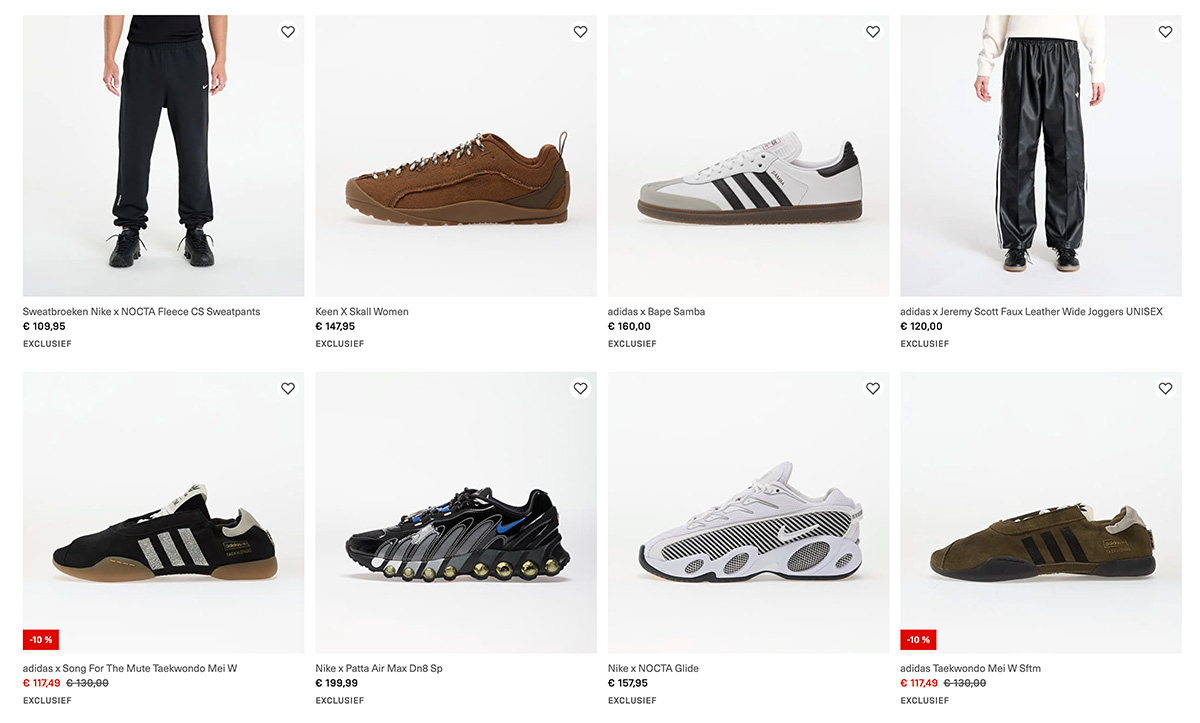
Nike can launch limited editions very quickly.
Ensure your model has room for experimentation. Sub-Brands are better at this than Branded House.
Trend 3 – Microsegments via data instead of guesswork
Companies use data to discover customer groups they didn't see. Marketing Automation, behavioural data, search behaviour; that provides insight. This can lead to sub-brands that are highly specific.
But here too the rule applies; only if customers understand it. Data may inspire you; it mustn't make your strategic choice. Customer logic comes first. Data logic follows.
Which model do you choose? A practical matrix
This is where theory stops and practice begins. You've now seen four models. But which one is for you? I've created a matrix you can use. Answer these questions honestly. Better cautious than too optimistic.
Question 1: how many totally different target groups do you have?
Not how many customers. How many totally different target groups; with genuinely different needs, different problems, different purchasing behaviour.

→ One target group; Branded House is your model
→ 2-4 target groups with overlap; Sub-Brands work well.
→ 2-4 target groups without overlap; Endorsed Brands or the hybrid model.
→ 5 or more totally different target groups; House of Brands.
Question 2: how quickly does your market change?
Tech? Gaming? Fashion? Then very quickly. Is it calmer; concrete industry, accountancy, property? Then you're in a less rapidly changing market.
→ Stable market (± 5 years the same trends); Branded House or Sub-Brands with fixed structure
→ Volatile market (trends change every six months); Sub-Brands with flexibility
Question 3: how much marketing budget do you realistically have?
This isn't what you want; this is what you actually have available.
→ Low (up to 5K per month); Branded House
→ Normal (5-15K per month); Sub-Brands or light Endorsed Brand
→ Large (15K+); House of Brands if you actually want to run it
Question 4: do my customers understand it in ten seconds?
This is the golden test. Tell your model to someone outside your company. Do they look puzzled or do they nod understandingly?
→ Yes; your model works
→ No; back to square one
Two cases from practice. What really works.
Theory is nice. But practice determines everything. Here are three cases in which I've had to think through brand architecture myself. Not a marketing tutorial book; real situations.
Case 1: the coach who wanted Sub-Brands, but needed Branded House
I worked with a business coach who offered three services; personal coaching, group coaching, online training. She wanted three separate brands. Much clearer, they thought. Each service would get its own identity. Three websites. Three marketing strategies.
I asked; What are your customers actually looking for?
She said; They're actually looking for me. My approach. My way of working.
Boom. There was the answer. Branded House became the right model. One strong personal brand. Three forms of working beneath it. The training was no longer Training Plus; it was part of hér system.
What happened? The marketing budget halved. She could focus on building one strong reputation instead of three sidesteps. Conversions rose 34 per cent, because customers no longer had to think; it was all tó the same coach.
The lesson: keep it simple when the core is the same. Your expertise is the anchor; the forms can differ.
Case 2: the multibranded company that had no strategy
An SME with five services came to me. The 5 services all operated with their own name and their own identity. I asked: Why five brands? The answer was the familiar phrase: It just grew that way.
Classic. No strategy; organic chaos.

A visual metaphor for brands that organically flew off the rails.
We created a matrix. Good question; which target audience did each brand have? Turned out two services served the same audience. Consolidation was obvious. The rest could sit under one masterbrand with three sub-brands.
Suddenly the story became clear. Customers understood it. Employees understood it. And the marketing budget was spread rather than split.
The lesson; not every service deserves a brand. Sometimes the opposite is true; multiple services can be powerful under one brand.
How to prevent your brand from diluting; five concrete steps
Now you know which model works for you, how do you put it into practice? Here are five steps you can take immediately.
Step 1: put yourself in your customer's shoes
Would you understand this? Would you grasp how everything fits together? Ask three people outside your business this. Their reaction is gold.
Step 2: make it explicit
Write down; Our model is Sub-Brands, because we want customers to understand that Marketing Coaching is different from LinkedIn Training, but both speak to our expertise.
Not; We happened to do that. Awareness is power.
Step 3: check whether brands can cannibalise each other
Customers choose Service A, but then lose Service B. Or vice versa. Cannibalisation. If you see this; consolidate.
Step 4: test your message
Can you explain your brand architecture in ten seconds? If not; too complicated. Simplify.
Step 5: review annually
Markets change. Businesses grow. Target audiences shift. Architecture isn't a statue; it's alive. Check every year whether your model still works.
In short: which brand architecture suits you?
The choice of the right brand architecture is strategic and personal. If you work in an organisation with multiple people who must embody the brand, then architecture is only the first step: how you anchor that structure in daily practice, deserves just as much attention. Take the time to choose — the foundation you lay determines how your brand grows. More about my approach or read about brand identity as a starting point.
The question you must ask yourself before building further
Before you launch more brands or restructure your portfolio; ask yourself: Am I doing this for my customers or for myself?
If the answer is for myself (because internally convenient, because it fits my organisational charts), stop. Go back to question one. What does your customer see?
This is the test. Not; Does this sound good? Rather; Does my customer understand this effortlessly?
Brand architecture isn't theory. It's strategy in practice. It determines your marketing ROI. It determines whether you grow or get lost.
Are you stuck with your brand strategy? I know how to get you through this. See here what I can do for you, or contact me via LinkedIn.